Theodor W. Adorno on education. Theodor W. Adorno (1903-1969) is one of the key thinkers of critical social theory. Beyond his writings on philosophy and sociology, he formulated interesting analyses around education. As Christian Spatscheck argues in this piece, his ideas are still relevant for today’s (informal) educators.
contents : introduction · life · adorno’s key educational concepts · the theory of half education · dialectic of enlightenment · education to maturity · the relevance of adorno for education today · references · about the writer · how to cite this piece
Theodor Ludwig Wiesengrund Adorno (1903-1969), philosopher, sociologist, music theorist and composer, was one of the key figures of the Frankfurt School of critical social theory. Under the influences of neo-Marxism and psychoanalysis, this group of researchers developed theories around the mechanisms of power and society. Such theory was critical in that amongst other things, it was rooted in a concern to question the ‘taken for granted’ and seeks human emancipation. As Horkheimer (1995: 246) put it, critical theory seeks ‘to liberate human beings from the circumstances that enslave them’. They gathered around the Institute of Social Research (Institut für Sozialforschung) (established in 1923)at Frankfurt University and included Max Horkheimer (the Institute’s Director from 1930), Herbert Marcuse, Erich Fromm, Walter Benjamin and, later on, Jürgen Habermas and Oskar Negt. Theodor Adorno became co-director in 1955).
Life
Theodor Adorno was born in Frankfurt am Main as a son of the wine merchant Oscar Alexander Wiesengrund (of Jewish origin, converted to Protestantism) and singer Maria Barbara Calvelli-Adorno (a Catholic of Corsican-Italian origin). Already as a child, Adorno developed his ongoing interest in classical music and was regarded as intellectually gifted. Also during his school years he had first encounters with anti-Semitism, which would influence his later work very strongly.
After only three years of studies in philosophy, musicology, psychology and sociology he graduated with a PhD thesis on Edmund Husserl at Frankfurt University in 1924. During the years 1925 and 1926 he studied music theory, composition and piano in Vienna. Here he was influenced by his teachers Alban Berg and Arnold Schoenberg and twelve-tone music. After his return to Frankfurt he finished his Habilitation on Kierkegaard ‘s aesthetics in 1931 (see Adorno 1933) and started to work as a Lecturer at Frankfurt University.
After the takeover of the National Socialists in 1933, he was impeached as a university teacher on grounds of his Jewish descent. Soon he realised that the Nazi dictatorship was to become more dangerous and fled to England, where he became a PhD student and teacher at Oxford’s Merton College (1934 to 1937). In 1938, he emigrated to the USA – staying there until 1949. There, his collaboration with Max Horkheimer continued, firstly at New York’s Columbia University and later on at the University of California in Los Angeles. During his American years, he worked on studies around the “Authoritarian Personality” and published his (later on) most influential work Dialectic of Enlightenment together with Max Horkheimer.
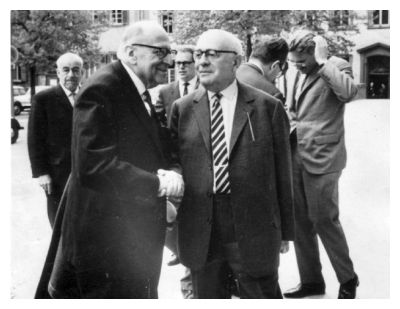 Theodor Adorno was not fully happy in the USA and gladly returned to Frankfurt in 1949. He found a position as a professor of philosophy and sociology at Frankfurt University, which he held until he died in 1969. In Frankfurt, Adorno (pictured front right in 1964 with Horkheimer and Habermas – in the background on the right) directly participated in the re-establishment of the Institute for Social Research (it had moved to the USA in 1934) and became a highly influential and publicly engaged philosopher who shaped many key intellectual debates in post-war Germany. He was especially engaged in the analysis of the legacy of totalitarian systems (see his books Minima Moralia and Negative Dialectic); philosophy’s and sociology’s critical function in society (the ‘positivism’ debate); and the critical dialogue with the emerging student movements and the extra-parliamentary opposition in 1968. Firstly, he sympathised with the students’ emancipatory movements; later on, he criticised totalitarian tendencies amongst the political left and also received criticism for his positions. During a vacation in Switzerland, and after leaving some major conflicts with students from Frankfurt University, he died in 1969 after having a heart attack.
Adorno’s key concepts on education
The foundations of Adorno’s thought can be found in his early studies on the “Authoritarian Personality” (Adorno et al. 1950). With his research team at the University of California, Berkeley, he searched for explanations for authoritarian behaviour, predominantly during the National Socialist regime in Germany but also within other totalitarian regimes. In his studies, he identified typical character attributes in persons that were growing up with authoritarian education: conventionalism, authoritarian submission, authoritarian aggression, anti-intraception, superstition and stereotypy, power and toughness, destructiveness and cynicism, projectivity, and exaggerated concerns over sex (Adorno et al. 1950: 228). Based on the studies on the Authoritarian Personality, he was looking for explanations for the existence of totalitarian systems and the possibilities for the prevention of authoritarianism.
Theory of “Half Education”
In his article “Theory of Half Education” (Theorie der Halbbildung, Adorno 1959), he argued that education (Bildung) in its full sense is continuously under threat of becoming reduced to a form of “half-education” (Halbbildung).
He regards education (Bildung) as a persisting area of conflict between an individual’s autonomy and their adaptation to the demands of society. Education therefore, entails an ongoing dialectic process between individual emancipation and the demands for submission to culture and society. Adorno’s concept of (full) education is clearly connected to the idea of Bildung used by educational reformers like Wilhelm von Humboldt, who regarded it as the highest possible development and perfection of the personality. This process is seen as necessary to gain full and free individuality. Here, education does not aim to reach “useful” purposes or material aims. Rather, it is designated to the long-term interest of the subject and its personal development.
With the term “half education” (Halbbildung) Theodor Adorno is referring to a disconnection from this dialectic. This could either happen if education is merely oriented towards certain purposes or if education is becoming ideology itself. This happens where the interests of the dominant groups in society define the aims of education, while, at the same time, neglecting the true interests of the subjects of education. The “survival of the fittest” becomes the remaining interest (Adorno 1959, 96).
Dialectic of Enlightenment
How can the tendencies towards “half education” be explained? Some explanations can be found in Horkheimer’s and Adorno’s book Dialectic of Enlightenment (Horkheimer/Adorno 1998. It was first published in English in 1947). Facing the cruelties of the Holocaust and based on empirical evidence from the studies on the Authoritarian Personality, Adorno and Horkheimer formulated a general critique of reason and rationality. This publication is often regarded as the most influential text for the critical theory of the Frankfurt School.
Enlightenment has always been based on reason. But reason continuously is in danger of becoming “instrumental reason”. Such a form of reasoning tries to govern nature, produces the “affirmation of the already existing” and invalidates the individual in an “administrated world” that is merely oriented to the interest of economic powers. Later on, Adorno described this phenomenon as the “double character of progress”: liberation is closely connected to tendencies of oppression (Adorno 1951, 167).
To escape this connection, reason needs to be reflected on where it leads to emancipation and where to new forms of submission. One key factor for this reflection is to have educated individuals.
Education to maturity
Under the title “Education to Maturity (Erziehung zur Mündigkeit, Adorno 1971a), a collection of radio interviews with Hellmut Becker from the years 1959-1969, was published after Theodor Adorno’s death in 1971. In these interviews, Adorno presented his ideas on education in a very accessible form. The aim was to illustrate his ideas about education towards personal and political maturity (Mündigkeit) (Adorno 1971a, 133).
The key article of this book, named “Education after Auschwitz” (Adorno 1971b), formulates the essence in the first sentence: “The premier demand upon all education is that Auschwitz not happen again”. Theodor Adorno describes the characteristics of the perpetrators and followers of the Holocaust as blind submission, the glorification of functions, no interest in self-determination and the treatment of others as anonymous members of a mass (Adorno 1971b, 97).
The only way to leave such personal short-sightedness behind is through an education towards autonomy, reflection and self-determination; an education that enables individuals to become resilient towards authoritarian tendencies (Adorno 1971b, 93). In this sense, education is a task for democratic societies, and real democracy can only be understood as a society of mature citizens and personalities (Adorno 1971a, 107). Therefore, education to maturity becomes the key strategy for enlightened societies.
The relevance of Adorno’s ideas for education today
Like all classic thinkers, Adorno is in danger of being treated as an important but distant authority, with dwindling relevance for the life of today (Bonß 2008). But many inspiring ideas can be found in his thinking.
Following his conviction “the whole is the untrue” (Das Ganze ist das Unwahre – first mentioned in his inaugural lecture in 1931), Adorno perceived his thoughts as ongoing streams of ideas rather than as closed systems of thought. As a critic of rationality, he followed the idea that in a world full of contradictions, thinking needs to stay contradictory as well. In this sense, he is still an inspiring thinker for current times of rapid changes, emerging risks and new challenges.
Translated into modern conditions, his ideas are leading to questions about education, like:
- Do we have the right conception of education itself? Is the current discourse about education creating autonomous and responsible human beings that are regarded as purposes of their own? Or is our conception of education rather oriented towards external purposes like employability, becoming a “useful” citizen or “good” market subject? Is education a commercial good that has to be subordinated to certain purposes? Or can education still be thought of as a purpose for itself?
- Can education be planned and standardised? Are the current strategies to measure education by achieved outcomes in exams and internationally standardised curricula meeting the core ideas of education towards maturity? Are we on the right track with strategies like the “Program of International Student Assessment” (PISA), the “Trends in International Mathematics and Science Study“ (TIMSS) or the creation of a standardised and strongly ruled “European higher education area” through the “Bologna process”?
- How do we meet tendencies towards authoritarianism and totalitarianism? Are we prepared to embrace people who are not willing to follow the hegemonic rules of society? Do our education systems prepare us to meet with groups that do not follow the mainstream of society, like minorities, subcultures, drug users, the “new underclass” or people who are not willing to adopt the leading ideas about sexuality, religion or work? Are we ready to live in a world that demands a growing tolerance for diversity? Or does our desire for order, orientation, and security still bring us to wish authoritarian solutions and to blame the “maladjusted”?
- Does our current form of education prepare us to the fullest and highest participation possible? Have we already reached the highest grade of democracy possible?
- Could informal education support the education of more capable subjects? Are the concepts of self-directed learning, holistic learning, learning with all senses and all talents, the possibilities for different ways of learning and the ideas of learning with personal and social reflexivity feasible to reach “full education” in Adorno’s sense?
Keeping in mind that education happens within an ongoing dialectic between individuals and the demands of society, education means an ongoing balancing of interests (Kappeler 1999). Neither functionalisation and the mere connection to hegemonic interests, nor the idea of absolute independence and individualism can solve this dilemma. Personal autonomy is always a socially connected situation that consistently has to be established and developed. Education therefore, means a persistent process of reflection about the needs of subjects and the challenges of society that can only be established in democratic collaboration with all participating actors.
References
Adorno, Theodor W. (1933) Kierkegaard: Construction of the Aesthetic, trans. R. Hullot-Kentor, Minneapolis: University of Minnesota Press.
Adorno, Theodor W. (1951): Minima Moralia. Frankfurt a.M., Suhrkamp. English version – (1951) Minima Moralia: Reflections from Damaged Life, trans. E. F. N. Jephcott. London: NLB
Adorno, Theodor W. (1959): Theorie der Halbbildung. In: Adorno, T. W. (1998): Gesammelte Schriften, Band 8; Darmstadt: Wissenschaftliche Buchgesellschaft, pp. 93-121.
Adorno, Theodor W. (1971a): Erziehung zur Mündigkeit. Vorträge und Gespräche mit Hellmut Becker 1959-1969. Frankfurt a.M., Suhrkamp.
Adorno, Theodor W. (1971b): Erziehung nach Auschwitz. In: Adorno (1971a), pp. 88-104
Adorno, Theodor W., Frenkel-Brunswik, E., Levinson, D. J., & Sanford, R. N. (1950): The Authoritarian Personality. New York: Harper and Row.
Bonß, Wolfgang. (2008): Wie weiter mit Theodor W. Adorno?. Hamburg, Hamburger Edition.
Horkheimer, Max/ Adorno, Theodor W. (1998): Dialektik der Aufklärung. Frankfurt a.M., Fischer (original: 1947). English version: (2002) Dialectic of Enlightenment: Philosophical Fragments (1947), ed. G. S. Noerr, trans. E. Jephcott. Stanford: Stanford University Press.
Kappeler, Manfred (1999): Rückblicke auf ein sozialpädagogisches Jahrhundert. Essays zur Dialektik von Herrschaft und Emanzipation im sozialpädagogischen Handeln. Frankfurt a.M., IKO.
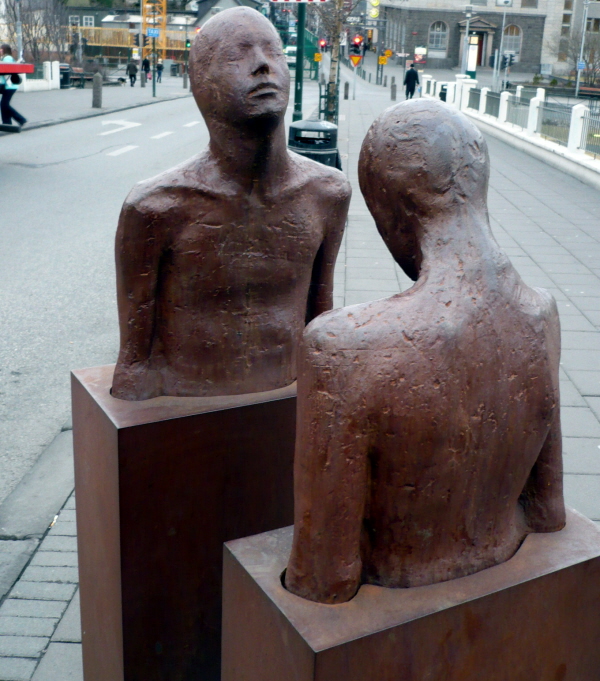
Acknowledgements: Picture – Sculpture in Reykjavik’s Laugavegur, taken by the author in February 2010.
The photograph of Horkheimer, Adorno and Habermas was taken in April 1964 by Jeremy J. Shapiro at the Max Weber-Soziologentag. Horkheimer is front left, Adorno front right, and Habermas is in the background, right, running his hand through his hair. Reproduced here under a Creative Commons Attribution-Share Alike 3.0 Unported license. Wikipedia Commons – Jjshapiro at en.wikipedia
About the writer: Prof. Dr. Christian Spatscheck is a Professor for Theories and Methodology of Social Work at the Faculty of Social Sciences of Bremen University of Applied Sciences. His main fields of work are theories and methodology of social work and social pedagogy, spatial and systemic paradigms, youth work and the international exchange on social work, social pedagogy and social development.
How to cite this article: Spatscheck, Christian (2010). ‘Theodor W. Adorno on Education’ The encyclopedia of pedagogy and informal education. Retrieved from www.infed.org/thinkers/adorno_on_education.htm on [add date].
© Christian Spatscheck 2010.
updated: August 4, 2025