
Social pedagogy: the development of theory and practice. The term social pedagogy has been used to describe a range of work straddling social work and education. Often more holistic and group-oriented than dominant forms of social work and schooling, social pedagogy (sozial pädagogik) has its roots in German progressive education – and is sometimes translated as ‘community education’ or ‘education for sociality’. Here we explore its history and current status.
Contents: introduction · the pedagogue in ancient Greece · Diestersweg, evolution and educational action to help the poor · Schleiermacher and societal development · Nartop, community and social pedagogy · national socialism and social pedagogy · social pedagogy and social work · social pedagogy and social education · social pedagogy and social group work · social pedagogy and community learning and development · some issues · conclusion · further reading and references · how to cite this piece
______
The term ‘social pedagogy’ has been used in countries such as Germany, Holland and Hungary to embrace the activities of youth workers, residential or day care workers (with children or adults), work with offenders, and play and occupational therapists (Galuske 2009). It has also been used to describe aspects of church work and some community development activity. In a few European countries the notion of animation is utilized to cover a similar arena of practice. With the growth of more integrated children’s services in Britain, there has been an interest in social pedagogy as a means of making sense of the professional development of staff in these areas of state service (Edwards and Hatch 2003; Cameron 2004; DfES 2005). There also has been some usage of the term from those seeking to explore classroom group work (e.g. Blatchford et. al. 2003). The emerging network of social pedagogues in Britain and Ireland has brought about the Social Pedagogy Professional Association and new training programmes.
As an idea sozial pädagogik first started being used around the middle of the nineteenth century in Germany as a way of describing alternatives to the dominant models of schooling. However, by the second half of the twentieth century social pedagogy became increasingly associated with social work and notions of social education in a number of European countries. Within the traditions that emerged there has been a concern with the well-being or happiness of the person, and with what might described as a holistic and educational approach. This has included an interest in social groups – and how they might be worked with (see social groupwork).
Some of its practitioners translate it as ‘community education’ others in more social work terms – for example around care. It can be seen as having three key pillars or traditions. A concern with:
- The nature of man and, in particular the extent to which individuals can only develop fully as part of society. Within this tradition of social pedagogy there is an emphasis upon social integration and socialization. This tradition has been described as ‘The Continental tradition’ by Eriksson, and Markström (2003)
- Social conditions and social problems. This tradition of social pedagogy found expression in the work of the university and social settlements in Britain and North America and in the development of social work. Eriksson, and Markström (2003) talk about this as ‘the American tradition’ and by this they are really focusing on social work. Within this element of the tradition there is an emphasis upon working with individuals, casework and providing care. In others there is more of an interest in and lessening the impact of inequalities in society, and dealing with social problems.
- Pedagogy – this tradition of social pedagogy has its roots in the work of educational thinkers and philosophers like Jean-Jacques Rousseau, Johann Heinrich Pestalozzi and John Dewey. More recently Paulo Freire has been especially influential in terms of helping people to frame their thinking.
As a result there are various debates about the nature of social pedagogy but the subtitle of a book edited by Claire Cameron and Peter Moss ‘Where care and education meet’ (2011) helps to set the scene.
As a starter it may be helpful to bear in mind the following elements. It is:
- A form of pedagogy and as such is rooted in education – and in the philosophy of people like Rousseau and Pestalozzi.
- Holistic in character – as Pestalozzi says, there is concern with head, heart and hand.
- Concerned with fostering sociality
- Based in relationship and care.
- Oriented around group and associational life (in contrast to much social work in the UK). Educators become part of the lifeworld of those involved (Smith 2012).
In this piece we explore the historical development of the concept, and some of the issues that inform its usage.
The pedagogue in Ancient Greece
To fully appreciate some of the debates around social pedagogy and the role of pedagogues it is worth going back to the distinction made between teachers and pedagogues in in ancient Greece. We know that people had ‘jobs’ as specialist educators. For example, Achilles had a tutor, Phoenix, who had the task of teaching him to be ‘both a speaker of words and a doer of deeds’ (reported in the ninth book of the Iliad). Some centuries later, in Athenian society, there were schools (perhaps based on earlier Babylonian models).
Pedagogues were family attendants (usually slaves) whose duties were to supervise, and be with, the young sons of the house. Chosen for their reliability (and sometimes their inability to undertake heavier duties), pedagogues took the boys to the gym and the school (and sat with them in the classroom). As E. B. Castle (1961: 63) has commented, this attendance of the pedagogue (paidagogos) on the boys was not purely protective.
The paidagogos was also expected to supervise his young charge’s manners in the home and in the street and even in school, where he was in attendance as a symbol of parental authority throughout the school day. This moral supervision by the paidagogos must be stressed. He was more important than the schoolmaster, because the latter only taught a boy his letters, but the paidagogos taught him how to behave, a much more important matter in the eyes of his parents. He was, moreover, even if a slave, a member of the household, in touch with its ways and with the father’s authority and views. The schoolmaster had no such close contact with his pupils. (Castle 1961: 63-4)
The low status of both teacher and pedagogue meant that they were frequently disrespected by the boys – and the hovering presence of the pedagogue was hardly likely to endear itself (op. cit.).
Diestersweg, evolution and educational action to help the poor
By the sixteenth century the notion of pedagogy had come to be understood as referring to the activities of tutors and school teachers. The notion of social pedagogy (sozial pädagogik) is said to have been coined in 1844 by Karl Mager (1810-1858) (he was editor of the Pädogische Revue from 1840-48). He used sozial pädagogik as an alternative to ‘Collectivpädagogik’ – and in contrast to ‘Individualpädagogik’ (van Ghent 1994: 95). However, it was the progressive Prussian educational thinker Friedrich Diesterweg (1790 – 1866) (whom Mager drew upon), who brought the idea to a broader audience. Diesterweg was exercised by the separation of theory and practice within teaching and is sometimes credited with originating the maxim ‘learn to do by doing’ (see Kliebard 1987: 37).
Friedrich Diesterweg looked to Rousseau, Pestalozzi and, later, Froebel in his educational writing (but was also well aware of classical Greek thought). He believed that people were able to develop, to respect and care for others, and to work for the good of the community (see Günther 1994: 296 – 297). He came to emphasise the idea of people carrying out their own activity, and of the fundamental importance of democracy, especially following the 1848 Revolution. Evolution was his central organizing idea:
The educational principle of evolution demands in the educational field: respect for human nature and of the individual; its stimulation to full development, expression, activity and initiative; natural, hence joyful, experience of life; stimulation to develop the senses, strengthening the body, to explore, to be lucid and to discover things; providing the minds with suitable nourishment; constant progress. It forbids: arbitrary assumptions and manipulations of human nature; any encouragement to act blindly and mechanically; any kind of drill; rote learning; uniformity; force-feeding with subject matter that is not understood etc. (quoted in Günther 1994: 297)
Diestersweg was keen to reform schooling – to take it away from the influence of the church and politics, and to turn it into a force for social change. He believed that general education should be open to everyone: ‘First educate men, before worrying about their professional training or class, [because] the proletarian and the peasant should both be educated to become human beings’. He went on to argue for social pedagogy: ‘educational action by which one aims to help the poor in society’ (1850, quoted in Cannan et al 1992: 73). Van Ghent comments, that as far as the poor were concerned, he did not distinguish between adolescents and adults, whereas such a distinction was necessary in the educational doctrines that were applied to the bourgeoisie. ‘The threat of socio-economic struggles was apparently considered to be far more dangerous than the conflicts between generations’ (van Ghent 1994: 96).
Schleiermacher and societal development
 What began to emerge was a conception of education concerned with societal (social) development. Here the earlier contribution of Friedrich Ernest Schleiermacher, the noted theologian and philosopher (1768-1834) was of some significance. He went ‘beyond the pedagogical principles of “natural self-development” to embrace an “education for community” (Gemeinschaft)’ (Lorenz 1994: 91). ‘Social’ in this sense could relate to the aim of the educational endeavour – the creation of community – and to the site for the process – in society. Examining Schleiermacher’s thinking, Lorenz says the following:
One of his theories is that individual intentions are already directed (by their nature as human intentions) towards sociability, towards universal social goals. The other is that only democracy allows the individual will to form. Public life needs to correspond to and reflect what is pedagogically, psychologically necessary for the healthy growth of the individual. The conditions for good education are those of a sound democracy; pedagogical and political processes condition each other. (op cit. 91-92)
This linking of pedagogy with community and democracy has remained a key theme – and can be seen in the work of later writers such as Dewey and Freire. However, it did not instantly recommend itself to those charged with responsibility for developing German schooling!
Natorp, community and social pedagogy
As the nineteenth century progressed, debates and insights around the idea of community developed (Dollinger 2006). For example, Tönnies (1855-1936) published Gemeinschaft and Gessellschaft (Community and Society) in 1887. There community was defined as ‘the permanent and real form of living together, while society is only transitory and apparent, and therefore community should be seen as a living organism and society as a mechanical aggregate and artefact’. It was this idea of community, van Ghent argues, that became fixed in one of the most influential versions of social pedagogy – that proposed by the prominent German philosopher Paul Natorp (1854-1924) (See Kim 2003 for a discussion of his philosophical work). According to him atomization had made Germany sick – what was needed was a strong sense of community (Gemeinschaft), education, and a fight to close the gap between rich and poor. Such education was to take place in three environments: ‘from the educating community of the household, through the national and uniform school, into the free self-education of adults of all social backgrounds’ (Marburger 1979 quoted in van Ghent 1994: 97).
Paul Natorp may have been a progressive but such a vision of social pedagogy can, in the hands of a paternalistic or totalitarian state, serve as a new form of social engineering and adjustment (see Lorenz 1994). It was to take such a turn under National Socialism
National socialism and social pedagogy
In a narrow and exclusive form, social pedagogy can become ‘education’ that directs the individual will towards the ‘higher level of a communal will’. For example Ernst Krieck argued for Nationalpolitische Erziehung (national-political education – ‘a totalitarian kind of education’, based on irrationalism (van Ghent 1994: 100). As Sunker and Otto (1997) have shown when the pivotal notion of ‘Volk community’ (Volksgemeinschaft) is introduced into the notion of social pedagogy there is considerable danger. They argue (following Franz Neumann), that the totalitarian state, the Führer principle, and the ideology of the Volk community are intertwined. National socialist rule involved putting total, authoritarian organization in the place of pluralism; and the atomization of the individual. This latter element entailed breaking down the influence of groupings such as the family, the church and unions and replacing them with an identity to the Volk community and to its guardians/leaders. In the Volk community social contradictions and conflicts are overcome. Character would be formed as part of a larger whole and one’s first duty was to the Volk. A pernicious twist comes in the politics of inclusion and exclusion. The Volk was one of ‘blood and soil’. Those of other ‘races’, those with disabilities, those who sought to question were not fit to be members.
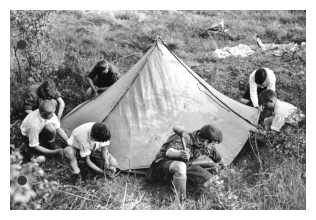
In Germany it was young people who were to become the particular object of such ‘education’ (see, for example, Becker 1946, Harvey 1993). Youth organizations such as the Bund Deutscher Mädel (League of German Girls) involved a strict separation of the adult world and that of youth. They assigned girls to youth and this allowed for their intervention in the ‘modernization’ of female life and in countering the influence of family (see Reese in Sunker and Otto 1997). ‘Because the state here penetrated by means of racist legislation into the most intimate spheres, in the area of the family, education, reproduction and the body, it displaced the personal bonds that were still dominant there and replaced them with new societal authorities and state violence’ (Reese 1997: 114). One of the particular forms utilized as an instrument of social discipline was the camp. Dudek (in Sunker and Otto 1997) has examined some of the key practices and ideas. For example, how the idea of team and service could be used to bind the behaviour of the individual and the camp community into the collective Volk community; and how ‘comradeship’ strengthened group identification. In a similar fashion Schiedeck and Stahlman have focused on the totalizing experience of education camps.
Social pedagogy and social work
Unsurprisingly, there was a reaction to this understanding of social pedagogy during post-war reconstruction. The fear that the educational socialization apparently implied within social pedagogy could be directed to the needs of the nation at the cost of individuals and of significant groups hung heavy. Moves towards more individual, problem-based work seemed a safer option than the mass and group work of the then-recent past. However, there was a limited counterbalance through the influence of writers such as Lewin (1948; 1951) on American ‘re-education’ efforts. He made a strong case for the use of small groups in the resolution of conflicts and the promotion of democracy. It was a theme also taken up by somewhat more pessimistically by Lindeman (who also advised the British army education service in Germany – see Stewart 1987: 212-214). Thus, as the German social welfare system evolved, social pedagogy did not take quite the course that Diestersweg envisaged. Rather than informing the shape of schooling it became seen as the ‘third’ area of welfare beside the family and school. It can be represented as:
a perspective, including social action which aims to promote human welfare through child-rearing and education practices; and to prevent or ease social problems by providing people with the means to manage their own lives, and make changes in their circumstances. (Cannan et al 1992: 73-74)
Conceived in this way it includes a wide range of practice including youth projects, crèches and nurseries, day-care centres, parent-education, work with offenders and some areas of church work. The linkage with social problems and crisis work situates social pedagogy alongside social work. Social work in Germany was divided into two major branches: Sozialarbeit (casework/management) and Sozial Pädagogik. The former can be seen as a ‘general social work service to families and other selected groups’ (Cannan et al 1992: 73). Workers in both areas undertook a common first foundation year of training (Sozial Wegen) and then specialized in the different approaches. Around half of those qualified as social workers in Germany trained as social pedagogues.
Social pedagogy and social education
Many of the ideas that informed debates around social pedagogy in the late nineteenth century began to influence developments in American educational thought. From the late nineteenth century on there was a US journal and community of practice centred around social education (see, for example, Scott 1908). Dewey, through the work of Hebart – and his knowledge of Rousseau, Froebel and Pestalozzi – sought to develop what could be described as child-centred theory. But he added to this a powerful dimension (and one that connects with the concerns of many early champions of social pedagogy) – that the experience required for learning was participation in community life (community was defined by Dewey in terms of sharing in a common life). Thus, his classroom was to be a community in itself – a place where there are group activities – where people cooperate. Teachers were to join in with the activities – to take part in a common endeavour. A critical point here is that Dewey saw the environment as social. People learn through interacting with a social environment.
This then links across to his – and other contemporary American writers – concern for democracy. People like Mary Parker Follett and Eduard Lindeman studied German developments. We can see a number of similarities with the concerns identified in Follett’s notion of training ‘for the new democracy’ (see la vie associative).
These ideas also aroused considerable interest amongst UK educators – especially those operating within what might be called the informal education tradition. They were reflected in some of the key post-war developments around community centres and associations, community work, community education and youth work. Perhaps the most significant shift in terms of practice was the reconceptualization of youth work as social education during the second half of the 1960s (see, in particular, the work of Davies and Gibson 1967). For a significant period ‘social education’ became the dominant way of describing both the content and the process of youth work. However, it was subject to some critique and gradually became less prominent – especially as ‘informal education’ came back into use and gained a stronger theoretical base (see Smith 1988).
The notion of social education (as being concerned with the relationship we have with ourselves, others and the world) also became an aspect of debates around schooling. Social and personal education, then social, personal and health education were part of the curriculum of many schools. Significantly, in terms of social work and care work, there was a trend in the 1970s of re-labelling centres for adults with special education needs as social education centres. Subsequently, other labels and concerns came to predominate – especially as schooling became more centralized and focused on achieving national curriculum and other state objectives. More recently in the UK with a growing interest in happiness and well-being, and appreciation of the problems of the individualistic and outcome turn that both schooling and social welfare have taken, there appears to be some movement towards the ‘social’ (see, for example, Layard and Dunn 2009).
Social pedagogy and social groupwork
The existence of a longstanding discourse around youth work and work with young people, and interest in social education help to explain why social pedagogy didn’t make much headway as the social professions developed in north America and Britain and Ireland. Another factor was the growing adoption of ways of thinking and practising drawn from social group work. As with some key traditions of social pedagogy there was in social group work concern with mutuality, self-help, and democracy. This was joined with a growing appreciation of group process and how more facilitative forms of intervention may happen.
Early proponents of social group work such as Grace Coyle drew heavily on the work of John Dewey – and others concerned with social education. They were also often strongly based in civil society (working in social and university settlements, the YWCA and YMCA and youth organizations). The setting for their activities was associational. Furthermore, a number of the key writers and researchers in the group work field had been forced to flee from National Socialism and this made its mark. Kurt Lewin (1948; 1951), for example, had an appreciation of some of the philosophical themes that could be found running through German traditions of social pedagogy but placed a strong emphasis upon democratic endeavour. Similarly, Gisela Konopka (1949; 1954; 1963) infused her work with compassion and a concern for justice. She warned about an over-emphasis upon technique. In Britain Josephine Klein (1956; 1961) had a strong grasp of the social setting of group activity and looked to the way in which decisions could be made in an informed way. However, as was the case with social pedagogy in Germany after the Second World War, group work in north America changed ‘its emphasis from social action and preparation of group members for social responsibility to problems of individual adjustment’ (Reid 1981: 154). Yet, within group work, as Allan Brown (1992: 8) has pointed out, while many workers are purely concerned to enhance individual functioning, others still look beyond helping the individual with a problem. Groupwork can emphasize ‘action and influence as well as reaction and adaption’ (op. cit.). It can, thus, be argued that:
… groupwork provides a context in which individuals help each other; it is a method of helping groups as well as helping individuals; and it can enable individuals and groups to influence and change personal, group, organizational and community problems. (Brown 1992: 8. Emphasis in the original)
A strong strand of ‘social goals group work’ remains (see, for example, Twelvetress 2008).
More recently the notion of social pedagogy has begun to be used as a way of conceptualizing group activity in classrooms (see Blatchford et. al 2003). However, in this literature thus far there has been little appreciation of social pedagogy as a longstanding tradition of thinking and practice.
Social pedagogy and community learning and development
In some respects the tradition of practice within English-speaking countries that has the strongest resemblance to social pedagogy (at least to those strands that retain an emphasis on community and sociality) is Scottish. The concern in Scotland from the early 1970s to develop a comprehensive approach to first, community education, and more recently community learning and development allowed for important innovations in practice. The Scottish Executive has argued that community learning and development ‘is a way of listening and of working with people’. The paper continued:
We define this as informal learning and social development work with individuals and groups in their communities. The aim of this work is to strengthen communities by improving people’s knowledge, skills and confidence, organisational ability and resources. Community learning and development makes an important contribution towards promoting lifelong learning, social inclusion and active citizenship. (Scottish Executive 2003)
There has been some tension between seeing community as the ‘place’ where learning and development happens, and community as the aim of intervention. There has also been resistance. Youth organizations have argued that young people have been marginalized, and community and voluntary groups have seen the framework applied strongly to the advantage of state-defined objectives and state-run services. This said, the community education, and then the community learning and development, framework have created potential for coherent practice.
Some issues
The history of social pedagogy highlights a number of issues and questions – especially linked into its usage within National Socialism. Here though we want to focus on three areas:
- Social pedagogy as a domesticating ideology.
- The pedagogue as an alternative way of constructing a professional framework and identity;
- The problem of pedagogy
Social pedagogy – domesticating or emancipatory?
Lorenz poses a a question of lasting significance:
Is social pedagogy essentially the embodiment of dominant societal interests which regard all educational projects, schools, kindergarten or adult education, as a way of taking its values to all sections of the population and of exercising more effective social control; or is social pedagogy the critical conscience of pedagogy, the thorn in the flesh of official agenda, an emancipatory programme for self-directed learning processes inside and outside the education system geared towards the transformation of society? (Lorenz 1994: 93)
This question has special significance given the nature of the ideologies that informed the activities of National Socialists in Germany during the 1930s and the first half of the 1940s. As we have already seen social pedagogy became ‘education’ that directed the individual will towards the ‘higher level of a communal will’. The issue also emerges in the experiences of a number of societies struggling to throw off the shackles of colonialism such as in the Indian social education programmes of the late 1940s (see Steele and Taylor 1994) and has been a feature of some of the educational debates around nationalism. The basic issue here is whether the vision of community or society entailed is pluralistic and democratic, or narrow and totalitarian (or even elitist). The former is concerned with education so that all may share in a common life (as Dewey put it); the latter with advantaging a particular group. When social pedagogy becomes detached from democratic pluralism it can quickly deteriorate into a pernicious form. The same could be said of many other aspects of social policy, but the particular use that social pedagogy was able to be put under National Socialism highlights our responsibility to take special care.
Professional identity – the pedagogue as an alternative paradigm
Some reading this will be resistant to the notion that they could be considered as social workers, others that they might be described as educators. Others, perhaps still used to the ways of discussing social work that are dominant in the UK, might be surprised at the extent to which education could be considered as part of the work. As Cannan et. al. (1992: 139) commented, within Britain there has been a long and political battle between two schools of activity – social work and community work.
This distinction exists in other European countries, but there is not quite the same separate philosophical or political rhetoric. Many people who work in community and social action programmes… in Britain, describe themselves as community workers or perhaps just project workers. There would be less shyness about using the term ‘social worker’ in many other European countries. (ibid.)
What is also of interest in the German and Danish traditions is the readiness of significant numbers of workers to describe themselves as pedagogues. Pedagogy and casework appeal to different theoretical traditions – but both provide insights to the other. Furthermore, and of significance in relation to the usage of the notion of informal education (as, say against youth work) in the UK, is the way in which the notion of social pedagogy similarly transcends particular organizational settings.
Social pedagogy defines the task and the process of all ‘social activity’ from theoretical positions beyond any distinct institutional setting and instrumental interest, and thereby safeguards the autonomy of the profession and appeals to the reflective and communicative abilities of the worker as the key to competence. Social work, by contrast, tends to take the diversity of social services and agency settings as the starting point for the search for appropriate theories, a search which used to be guided by the desire to find a general, unifying theory of social work but has since given way to the more pragmatic and often eclectic use of theory elements from neighbouring disciplines. (Lorenz 1994: 97)
Just how autonomous practitioners can be within state-funded agencies is a matter of some debate – especially where they are in settings that are dominated by contrasting or antagonistic ideologies. However, Lorenz does have a point. The taking of the notion of ‘pedagogy’ into the way in which you name yourself makes a direct appeal to a particular body of theory and practice – and a particular paradigm.
It is this paradigm – especially the holistic view of the child that runs through social pedagogy, and the pedagogy tradition that can be found in Denmark – that has appealed to a number of commentators trying to make sense of developing the children’s workforce in Britain. In Scotland in particular, there has been a significant discussion around the introduction of a ‘new profession’ – the Scottish pedagogue (see, for example, Children in Scotland 2008). This profession could embrace the activities of classroom assistants, residential care workers, family support workers, family and children centre workers, youth workers and so on. Browen Cohen (2008) and others have argued that pedagogy should be the central basis for workforce reform.
Rather oddly, very little attention in this has been given to the approaches and understandings already generated within the Scottish tradition of community education and community learning and development (see above). Perhaps one of the reasons for this has been the readiness on the part of proponents to abandon the notion of the ‘social’ in the interest of using the pedagogue paradigm to embrace a wide range of existing occupational groups. Even where the ‘social’ is retained within recent British discussion however, a rather narrow appreciation has been dominant. This has largely been the result of the location of the debate within the largely individualistic and deficit frameworks of contemporary social work and social care. What all of this loses is an orientation toward a pedagogy for sociality – one that involves engagement with associational life, civic society, and local social systems.
The problem of pedagogy
A further set of issues and complications arises from the the usage of the term ‘pedagogy’ to describe the process. Here three particular issues arise. First, there is the problem of at whom the process is aimed. Etymologically, pedagogy is derived from the Greek paidag?ge? meaning literally, ‘to lead the child’. In common usage it is often to describe the principles and practice of teaching children. Much of the work that ‘social pedagogy’ has been used to describe has been with children and young people. While writers like Paulo Freire (1972) have used the notion of pedagogy to refer to working with adults, there are others who argue that it is inextricably linked to teaching children. For example, Malcolm Knowles (1970) was convinced that adults learned differently to children – and that this provided the basis for a distinctive field of enquiry. He, thus, set andragogy – the art and science’ of helping adults learn – against pedagogy. We might wish to question the assertion that the way in which children and adults learn is significantly different – but what does tend to be true is that educators tend to approach them differently and employ contrasting strategies.
Second, there are questions around the extent to which the notion of pedagogy has been formed by the context in which it is predominantly sited – the school. When we use the term are we importing assumptions and practices that we may not intend? Discussion of pedagogy is invariably linked to notions such as curriculum, instruction and subject. As such it may well be useful for thinking about aspects of what informal educators and animateurs do, but is much less helpful for exploring conversational and convivial forms of practice.
Third, and linked to the above, as Street and Street (1991: 163) highlighted with respect to Freire, there is the danger of the ‘pedagogization’ or ‘schooling’ of everyday life:
When we participate in the language of an institution, whether as speakers, listeners, writers, or readers, we become positioned by that language; in that moment of assent, myriad relationships of power, authority, status are implied and reaffirmed. At the heart of this language in contemporary society, there is a relentless commitment to instruction.
Our language use as workers, and the way in which we define space can act to constrain exploration and to subordinate people.
Conclusion
The notion of social pedagogy offers an interesting set of paradigms for informal and non-formal educators – especially where it highlights education for sociality. The social education and social group work traditions carry within them some overlapping concerns, but it has been the Scottish community education and then community learning and development tradition which provided the closest approximation to the spirit of social pedagogy. These traditions have brought back into the discourse a concern with both education and animation. The way that ‘social pedagogy’ and ‘pedagogue’ has been used within the UK (from a social care perspective) has tended to strip away its democratic and communal significance reducing it to a pedagogy for case management. It is very different to the notions of pedagogy within informal education and community learning and development. The animation-care-education model of process that is based in these traditions takes us in a rather, and more authentic, direction (Smith 2019).

It shows that in the end, we need to recognize the significance of informal education, group work and community organization and development as traditions of practice that inform social pedagogy.
Further reading
There is a marked shortage of English-language explorations of social pedagogy and animation. However, the situation is slowly changing – and here we are particularly indebted to the work of Walter Lorenz and Claire Cameron and Peter Moss.
Cameron, C. and Moss, P. (eds.). (2011). Social Pedagogy and Working with Children and Young People: Where Care and Education Meet. London: Jessica Kingsley. This edited collection is, without a doubt, the best recent treatment in English of social pedagogy. Written largely from within the tradition of UK social work it has less of a grip of pedagogy and community than some of the traditions discussed here, but it provides an excellent route into exploration.
Lorenz, W. (1994) Social Work in a Changing Europe, London: Routledge. 206 + xii pages. Excellent discussion of social work in Europe in the twentieth century – especially strong on animation and social pedagogy. Chapters on social work within different welfare regimes; ideological positions; social work Fascism and democratic reconstruction; social work and social movements; social work , multiculturalism and anti-racist practice; and emerging issues.
Other references
Becker, H. (1946) German Youth: Bond or free? London: Kegan Paul, Trench, Trubner and Co.
Bellersen, H. (1928) Die Sozialpädagogik Paul Natorps im Lichte der christlichen Weltanschauung. Paderborn.
Blatchford, P., Kutnick, P., Baines, E. and Galton, M. (2003) ‘Toward a social pedagogy of classroom group work’, International Journal of Educational Research 39: 153–172.
Brown, A. (1992) Groupwork. London: Heinemann.
Cameron, C. and Boddy, J. (2005) With Heart, Head and Hands. Community Care, 19th – 25th May 2005, pp 36-37.
Cameron, C. (2004) Social Pedagogy and Care: Danish and German practice in young people’s residential care, Journal of Social Work. Vol 4, no 2, pp 133 – 151.
Cameron, C. and Moss, P. (eds.). (2011). Social Pedagogy and Working with Children and Young People: Where Care and Education Meet. London: Jessica Kingsley.
Cannan, C., Berry, L. and Lyons, K. (1992) Social Work and Europe, London: Macmillan.
Cannan, C. and Warren, C. (eds.) (1997) Social Action with Children and Families. A community development approach to child and family welfare, London: Routledge.
Castle, E. B. (1961) Ancient Education and Today. Harmondsworth: Pelican.
Children in Scotland (2008) Working it out: Developing the children’s sector workforce. Edinburgh: Children in Scotland.
Cohen, B. (2008) ‘Introducting “The Scottish Pedagogue”‘ in Children in Scotland Working it out: Developing the children’s sector workforce. Edinburgh: Children in Scotland.
Davies, B. and Gibson, A. (1967) The Social Education of the Adolescent, London: London University Press.
Department for Education and Skills (2005) Children’s Workforce Strategy. A strategy to build a world-class workforce for children and young people, London: Department for Education and Skills. http://www.dfes.gov.uk/consultations/downloadableDocs/5958-DfES-ECM.pdf
Dewey, J. (1916) Democracy and Education. An introduction to the philosophy of education (1966 edn.), New York: Free Press.
Dewey, J. (1933) How We Think. A restatement of the relation of reflective thinking to the educative process (Revised edn.), Boston: D. C. Heath
Dewey, J. (1938) Experience and Education,New York: Collier Books. (Collier edition first published 1963).
Dollinger, B. (2006) Die Pädagogik der Sozailen Frage. (Sozial-) pädagogische theorie vom beginn ders 19. jahrhunderts bis zum ende der Weimarer Republik. Wiesbaden: VS-Verlag f?r Sozialwissenschaften.
Edwards, L and Hatch, B. (2003) Passing Time: a report about young people and communities, London: Institute of Public Policy Research. Key findings are available in the informal education archives: http://www.infed.org/archives/e-texts/ippr_passing_time.htm; full report: http://www.ippr.org/publications/files/PassingTimefinalreport.pdf
Eriksson, L. and Markström, A-M (2003). ‘Interpreting the concept of social pedagogy’ in Anders Gustavsson, Hans-Erik Hermansson & Juha Hämäläinen. Perspective and theories in social pedagogy. Göteborg: Daidalos.
Follett, M. P. (1918) The New State. Group organization the solution of popular government (3rd impression [1920] with introduction by Lord Haldane), London: Longmans Green.
Freire, P. (1972) Pedagogy of the Oppressed. Harmondsworth: Penguin.
van Ghent, B. (1994) ‘The invention of Dutch andragogy: The role of Octavia Hill and Paul Natorp’ in S. Marriott and B. J. Hake (eds.) Cultural and Interculteral Experiences in European Adult Education. Essays on popular higher education since 1890, Leeds:University of Leeds.
Galuske, Michael (2009) Methoden der Sozialen Arbeit: Eine Einführung. Auflage: Juventa.
Gunn, G. (1992) Thinking Across the American Grain. Ideology, intellect and the new pragmatism, Chicago: University of Chicago Press.
Günther, K-H. (1994) ‘Friedrich Adolph Wilhelm Diesterweg’ in Z. Morsy (ed.) Thinkers on Education, Paris: UNESCO.
Harvey, E. (1993) Youth and the Welfare State in Weimar Germany, Oxford: Oxford University Press.
Kim, A. (2003) ‘Paul Natorp’, Stanford Encyclopedia of Philosophy. [http://plato.stanford.edu/entries/natorp/. Accessed January 19, 2009].
Klein, J. (1956) The Study of Groups. London: Routledge and Kegan Paul.
Klein, J. (1961) Working with groups : the social psychology of discussion and decision. London: Hutchinson.
Knowles, M. S. (1970) The Modern Practice of Adult Education. Andragogy versus pedagogy, Englewood Cliffs: Prentice Hall/Cambridge.
Konopka, G. (1949). Therapeutic Group Work with Children. Minneapolis: University of Minnesota Press.
Konopka, G. (1954). Group Work in the Institution – A Modern Challenge. New York: Association Press.
Konopka. G. (1963). Social Group Work: A Helping Process. Prentice Hall, Englewood Cliffs, NT.
Layard, R. and Dunn, J. (2009) A Good Childhood: Searching for Values in a Competitive Age. London: Penguin.
Lewin, K. (1948) Resolving Social Conflicts. Selected papers on group dynamics, New York: Harper and Row.
Lewin, K. (1951) Field Theory in Social Science, New York: Harper and Row.
Linton, D. S. (1991) ‘Who has the youth has the future’ The campaign to save young workers in imperial Germany, Cambridge: Cambridge University Press.
Natorp, P. (1899) Sozialpädagogik. Theorie der Willensbildung auf der Grundlage der Gemeinschaft. Stuttgart: Frommann [1922 edn].
Natorp, P. (1907) Gesammelte Abhandlungen zur Sozialpädagogik. Stuttgart.
Otto, H-U. and Thiersch, H. (2005) Handbuch Sozialarbeit / Sozialpädagogik (Gebundene Ausgabe). Munchen: Reinhardt.
Pestalozzi, J. H. (1885) Leonard and Gertrude. Republished 2010 by General Books, Memphis.
Petrie, P. (2002) Social Pedagogy: An historical account of care and education as social control, in Brannen, J. and Moss, P. (eds.) Rethinking Children’s Care, Buckingham: Open University Press.
Reid, K. E. (1981) From Character Building to Social Treatment. The history of the use of groups in social work, Westport, Connecticut.
Scottish Executive (2003) Working and learning together to build stronger communities. Working draft Community Learning and Development Guidance, Edinburgh: Scottish Executive. Available in the informal education archives: http://www.infed.org/archives/gov_uk/working_together.htm.
Smith, M. (1988) Developing Youth Work. Informal education, mutual aid and popular practice, Milton: Keynes: Open University Press.
Smith, M. K. (2019). Haltung, pedagogy and informal education, Developing Learning. [https://infed.org/dir/haltung-pedagogy-and-informal-education/. Retrieved: June 11, 2019].
Steele, T. and Taylor, R. (1994) Learning Independence. A political outline of Indian adult education, Leicester: National Institute of Adult Continuing Education.
Stewart, D. S. (1987) Adult Learning in America. Eduard Lindeman and his agenda for lifelong education, Malabar, Florida: Krieger.
Sunker, H. and Otto, H-U. (eds.) (1997) Education and Fascism. Political identity and social education in Nazi Germany, London: Taylor and Francis.
Twelvetrees, A. (2008) Community Work. London: Macmillan/Palgrave.
Acknowledgements: Opening image – Together we create – is by “My Life Through A Lens” on Unsplash. The illustration of Friedrich Daniel Ernst Schleiermacher is believed to be in the public domain and was sourced from Wikipedia Commons. The photograph of a group of Hitler Youth erecting a tent is taken from the German Federal Archive http://www.bild.bundesarchiv.de/archives/barchpic/search/?search%5Bform%5D%5BSIGNATUR%5D=Bild+146-2004-0034 and believed to be in the public domain (it has been placed in the Wikipedia Commons).
How to cite this piece: Smith, M. K. (2019) ‘Social pedagogy’ in The encyclopedia of pedagogy and informal education, [https://infed.org/dir/social-pedagogy-the-development-of-theory-and-practice/. Retrieved: insert date].
© Mark K. Smith 1999, 2007, 2009, 2012, 2019
updated: August 21, 2025