Using focus groups in evaluation and research. Focus groups have been part of market research for many years. Their popularity in advertising and marketing – and their use to find new ways of getting us to buy particular products or ideas – puts off a lot of people. However, they are a very useful tool in evaluation. In this short guide we look at the nature of focus groups, what they can be best used for, and the practical tasks involved in running them.
contents: introduction · what are focus groups used for? · before the group meets · the focus group meeting · making sense of the data · further reading and references · how to cite this piece
Focus groups are a form of group interview. Like any other research or evaluation tool their purpose is to gather information. Through listening and observing interactions focus groups can help us to appreciate how people think and feel about an experience, issue or a service. They involve:
- Bringing together around 5-10 people with particular characteristics (which are seen to be representative of the group of people that are being researched).
- The exploration of a particular theme or topic(s) – and the gathering of opinions.
- A relaxed atmosphere.
- A focus on interaction. Unlike standard interviews where the discussion depends upon the interviewer asking questions, and the group responding, in focus groups data emerges from group interaction.
- Meeting for around one to one and half hours.
- Several meetings with similar groups of participants (so that we identify patterns and trends). Usually this means a minimum of three focus groups.
- Recording. Most focus group sessions are recorded (usually by audio) with notes also often being kept by the facilitator and, where observers are involved, by them.
As one popular guide put it:
A focus group study is a carefully planned series of discussions designed to obtain perceptions on a defined area of interest in a permissive, nonthreatening environment. Each group is conducted with 5 to 10 people led by a skilled interviewer. The discussions are relaxed, and often participants enjoy sharing their ideas and perceptions. (Krueger and Casey 2009: 1)
Focus groups work best when people feel free to give their opinions without being judged. In addition, they can often be more successful if they are made up of relative strangers (unless the subject matter is something that is usually only talked about amongst friends) (Cohen et.al. 2000: 288-9).
What are focus groups used for?
Focus groups are useful for:
- Gathering feedback on activities, projects and services.
- Generating and evaluating data from different groups that use a service or facility, or that an agency wants to target.
- Generating and evaluating data from different groups within a local community or population.
- Developing topics, themes and questions for further research activities like questionnaires and more detailed interviews.
They are good in use in conjunction with other forms of evaluation as they can help ‘triangulate’ findings (Cohen et. al. op. cit).
Evaluation objectives
It is worth spending some time getting clear on the objectives for the evaluation – and where focus groups fit into these. We need to be clear what issue or area will be covered by the information we gather from the group.
Before the group meets
The success of focus groups depends significantly on the quality of our preparation – and our clarity around what we need from the evaluation.
Group profile
Getting the group profile right is central. As one commentator put it, ‘If the right people are not recruited for a focus group, the information that the session generates may be unhelpful or even worthless’ (Greenbaum 1998: 61). Failure in this area is one of the commonest mistakes made with focus groups. Participants must:
- Represent in some important way the characteristic you are looking for.
- Know about the area of work or the issue that you are exploring.
- Not be just drawn from regular users or participants in a project or service. They are more likely to be satisfied – and evaluations need to know about what is going well, and what is going wrong.
In addition, you need to try to create a focus group that is relatively homogenous. Participants need to relate to each other and to feel that they share certain things in common. Here it is worth thinking about separating males from females; and having reasonably tight age bands. It is also necessary to, and, depending on the focus of the discussion attending to other characteristics like the area they are from, educational background and ethnicity.
Organising a focus group
There are some basics here:
- The focsu group meetings need to be 1 to 1½ hours long. Work out what the best day and best time will be for likely participants.
- Setting is important – choose somewhere where the group will not be disturbed, and that will create the right environment for open exploration. Provide refreshments and organise the room so that everyone can see each other (usually a circle).
- Make sure people have enough notice to attend the focus group and remind them two or three days beforehand.
- Get together a basic kit of resources for the group including attendance list; flip charts and markers; pens, pencils and paper; badges; audio recorder; plus any special materials you might need for particular activities.
Shaping the meeting and developing your questions
While a lot has been written about the different stages that groups and sessions go through, probably the most useful is the most obvious (Smith 2009). Sessions have beginnings, middles and ends – each with its own task. These are concerned with the 3e’s:
- encouraging exploration,
- engaging with the subject, and
- enabling people to move on.
Gail Evans has suggested that within helping conversations (and for us facilitating sessions) it is worth thinking in terms of the exploration as the first quarter of the focus group session; engaging with the subject and developing understanding as the middle half; and enabling action and development as the final quarter (2007: 131).
In a session of 1½ hours it is only really possible to address five or six questions. Below we suggest some possible questions for young people; local community members; and stakeholders. However it is worth thinking about a basic format for the focus group e.g.:
1. General topic (to encourage conversation and participation and set the scene)
2. Primary topic (one of the main areas you want to explore).
3. Third topic
4. Fourth topic …
5. Close – summing up
In framing questions it is vital that we encourage people to define subjects and areas in their own terms. We need to avoid using our own technical language and categories to organise the topics for the focus group.
The focus group meeting
Most people reading these notes will have expertise as facilitators – but it is worth highlighting a few points. As Roger Schwarz (2002: 41-2) has commented, facilitators:
- Have to stand apart from groups yet be acceptable to them. They have to be seen as a third party.
- Have to earn the space to facilitate – and they do this by doing their job well and being neutral – not taking sides.
- Are not the decision-makers, nor mediators. It is difficult to facilitate sessions where you have ‘decision-making authority’.
Beginnings – encouraging exploration
The core purpose of this part of the focus group meeting is to put participants at ease, to provide focus for the session, and to encourage exploration (see Smith 2009).
The basic elements are:
- Establishing the focus of the session. Setting up the question or issue that we are going to explore. Telling participants about the general purpose of the group, what they will be doing and the time involved e.g. ‘We are going discuss several areas in this meeting. Our primary goal Is to discuss your opinions about …. ‘
- Encouraging trust. Acting so that people are disposed to work together with the facilitator to create an environment in which all can participate. Part of this involves communicating our concern for an open discussion in which all feel free to participate. We can highlight certain ground rules/discussion guidelines for the focus group. The obvious ones here concern people talking one at a time, speaking so that others can hear, keeping to the focus/task and the role of the facilitator in containing the discussion and moving on to other topics. We also need to explain what is said is being recorded, used for research and evaluation; that what is discussed is analysed as a whole and their names will not be used.
- Helping people to engage with the subject and each other. Here, when facilitating a group, we might pose some initial ‘easy’ questions or open up conversations. However, first we need some introductions – to each other, and to any other people who may be present and helping with the evaluation.
The advice that many commentators give in this area is to begin with non-threatening questions like ‘Could you tell us about the things you are involved in the centre?’ Another key piece of advice is to encourage everyone to join in this discussion.
Middles – engaging with the subject and generating material
The middle part of the session involves facilitating a deepening of the exploration so that we and the other participants gain a better understanding of the issue or question.
- You will probably have 4-5 topics to cover so it is important to make sure you attend to time. Under each topic it is worth:
- Asking any more precise questions about the topic later rather than earlier. We need to encourage people to share their experiences initially without too much direction.
- Use different techniques as starters for exploration e.g. completing sentences, filling in ‘bubbles’ (where two people(or animals or objects) are talking to each other – what are they saying to each other), or getting people to react to statements about the project/work/issue.
- Encouraging exploring behaviour or ‘doing’ questions before attitude questions. In other words, encourage people to tell stories about their experiences.
- Trying to avoid putting ‘words into people’s mouths’.
Endings – summing up and enabling people to move on
This final part of the session is concerned with helping people to make an assessment of their understanding of the issues or questions that were the focus of the session. The key tasks entail enabling people to:
- Take stock. The aim here is to help us take stock of where the discussion got to. We might do this as a whole group activity, or ask people to work individually, in pairs or in small groups.
- Identify any key points for the evaluation. As facilitators we also need to make sure not to make any promises about what the agency/project might do in response.
- Manage the end of the session. Here the task is to help people to finish off the business of the session – and to begin to make themselves ready for what they are going to do next.
Making sense of the data
Getting the information, as is always the case in evaluation, is only half the work. The task is then to make sense of it – and to draw out conclusions. Here we make some key points with regard to focus groups.
First, it is worth bearing in mind that each focus group discussion builds on the one before – and this means that as we get into a series of groups our set of themes for discussion is likely to develop and, hopefully, become more focused.
Second, if two or more evaluators/researchers are involved in the focus group it is important to meet, compare and review notes around the topics – and evaluate how the group went.
Third, while it is worth reviewing any recording – and making notes on what is being said (if you are not doing a full transcription) – it is probably worth waiting until you have done two or three before you try to ‘code’ – categorise the material into different themes and issues.
Further reading and references
Evans, Gail (2007). Counselling Skills for Dummies. Chichester: John Wiley.
Greenbaum, T. L (1998). The Handbook for Focus Group Research. Thousand Oaks CA.: Sage.
Krueger, R. A. and Casey, M. A. (2009). Focus Groups: A practical guide for applied research 4e. Los Angeles: Sage.
Schwarz, Roger M. (2002). The Skilled Facilitator: A Comprehensive Resource for Consultants, Facilitators, Managers, Trainers and Coaches. 2e. San Francisco: Jossey-Bass.
Smith, M. K. (2001; 2009). ‘Facilitating learning and change in groups’, The encyclopedia of pedagogy and informal education. [www.infed.org/biblio/b-facil.htm].
Useful websites
Focus Group Tips: http://www.focusgrouptips.com/index.html
How to cite this piece: Smith, M. K. (2011). ‘Using focus groups in evaluation and research’, the informal education homepage. [https://infed.org/dir/using-focus-groups-in-evaluation-and-research/. Retrieved: insert date].
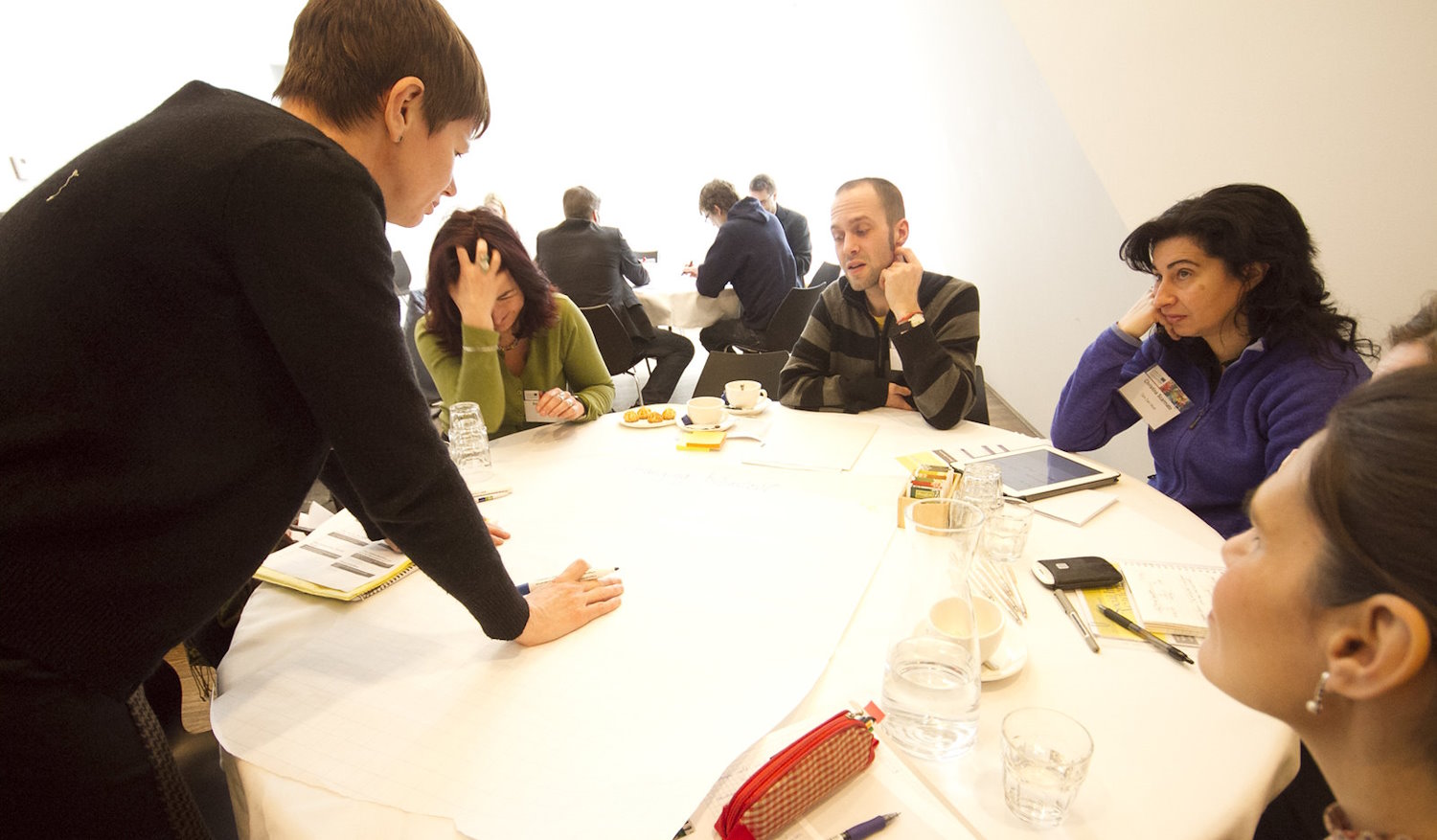
Acknowledgements: The image of the focus group on working principles is by Pennisland flickr | ccbysa4deed
© Mark K. Smith 2009, 2011
updated: August 14, 2025