
Few educators speak of praxis. Those that do tend to link it to the work of Freire. Yet while praxis may not be part of many educators’ overt vocabulary, practice, a pale derivative, is. So what is praxis and why should educators be concerned with it?
contents: · theory and practice · practical reasoning · praxis – informed, committed action · further reading · how to cite this piece
Man must prove the truth, i.e. the reality and power, the this-sideness of his thinking in practice…. All social life is essentially practical. All mysteries which lead theory to mystics, find their rational solution in human practice and in the comprehension of this practice…. The philosophers have only interpreted the world, in various ways; the point is to change it. (Marx 1845 Theses on Feurbach: II, VII, XI)
Many educators are involved with praxis – acts that shape and change the world – but it often isn’t part of their vocabulary. In this short piece, we examine the notion of praxis and of ‘education for use’ (Lindeman 1944: 103).
Theory and practice
Practice is often depicted as the act of doing something. It is usually contrasted to ‘theory’ – abstract ideas about some ‘thing’ or phenomenon. In this ‘theory’ tends to be put on a pedestal. From theory, general principles (or rules) can be derived. These in turn can be applied to the problems of practice. Theory is ‘real’ knowledge while practice is the application of that knowledge to solve problems. In many ways, this is a legacy of Aristotle and his three-fold classification of disciplines as theoretical, productive or practical. The basis of the distinction lies in the telos, or purpose, each serves. In brief:
The purpose of a theoretical discipline is the pursuit of truth through contemplation; its telos is the attainment of knowledge for its own sake. The purpose of the productive sciences is to make something; their telos is the production of some artefact. The practical disciplines are those sciences which deal with ethical and political life; their telos is practical wisdom and knowledge. (Carr & Kemmis 1986: 32)
This way of separating areas of knowledge can be seen, for example, in the way that we might view ‘pure maths’ (theoretical), tool-making (productive), and social work training (practical).
If the form of thinking associated with theoretical activities was contemplative, the enquiry involved in productive disciplines was a ‘making’ action or poietike. Aristotle associated this form of thinking and doing with the work of craftspeople or artisans. Hence, the making action is not simply mechanical. It also involves some creativity. This making action is dependent upon the exercising of skill (techne). It always results from the idea, image or pattern of what the artisan wants to make. In other words, the person has a guiding plan or idea. For example, potters will have an idea of the article they want to make. While working, they may make some alterations, develop an idea and so on. But they are restricted in this by their original plan.
Practical reasoning
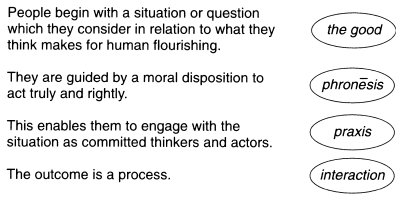
Where the productive begins with a plan or design, the practical cannot have such a concrete starting point. Instead, we begin with a question or situation. We then start to think about this situation in the light of our understanding of what is good or what makes for human flourishing. Thus, for Aristotle, praxis is guided by a moral disposition to act truly and rightly; a concern to further human well-being and the good life. This is what the Greeks called phronesis and requires an understanding of other people.
Practical wisdom (phronesis) involves moving between the particular and the general.
The mark of a prudent man [is] to be able to deliberate rightly about what is good and what is advantageous for himself; not in particular respects, e.g. what is good for health or physical strength, but what is conducive to the good life generally. (Aristotle 2004: 209)
In praxis, there can be no prior knowledge of the right means by which we realize the end in a particular situation. For the end itself is only specified in deliberating about the means appropriate to a particular situation (Bernstein 1983: 147). As we think about what we want to achieve, we alter the way we might achieve that. As we think about the way we might go about something, we change what we might aim at. There is a continual interplay between ends and means. In just the same way there is a continual interplay between thought and action. This process involves interpretation, understanding and application in ‘one unified process’ (Gadamer 1979: 275). It is something we engage in as human beings and it is directed at other human beings.
Shirley Grundy (1987: 64) has helpfully set this process diagrammatically – and a version of this (from Smith 1994) can be seen below.
The practical – making judgements
Praxis: informed, committed action
We can now see the full quality of praxis. It is not simply action based on reflection. It is action which embodies certain qualities. These include a commitment to human well-being, and the search for truth, and respect for others. It is the action of free people, who can act for themselves. Moreover, praxis is always risky. It requires that a person ‘makes a wise and prudent practical judgement about how to act in this situation’ (Carr and Kemmis 1986: 190).
‘In pedagogy’, Gadotti (1996) writes, ‘the practice is the horizon, the aim of the theory. Therefore the educationalist lives the instigating dialectic between his or her daily life – the lived school and the projected school – which attempts to inspire a new school‘
As Paul Taylor (1993) has written, we can say that word and action, action and reflection, theory and practice are all facets of the same idea. This action is not merely the doing of something, what Freire describes as activism and Aristotle as poiesis. Poiesis is about acting upon, doing to: it is about working with objects. Praxis, however, is creative: it is other-seeking and dialogic. praxis praxis praxis praxis
Further reading and references
Aristotle (2021).The Nicomachean Ethics. Trans. Adam Beresford London: Penguin. 383 pages. A refreshing approach to translating this text avoids ‘the scholars’ dialect that is traditionally used for translating Aristotle’ and starts from scratch. Book six deals with intellectual virtues – prudence, wisdom etc.
Carr, W. and Kemmis, S. (1986) Becoming Critical. Education, knowledge and action research, Lewes: Falmer. Influential book that provides a good account of ‘praxis’ in education. Chapters on teachers, researchers and curriculum; the natural scientific view of educational theory and practice; the interpretative view of educational theory and practice; theory and practice – redefining the problem; a critical approach to theory and practice; towards a critical educational science; action research as critical education science; educational research, educational reform and the role of the profession.
Freire, P. (1972) Pedagogy of the Oppressed, London: Penguin. 153 pages. One of the most significant books published on education in the second half of the twentieth century. Chapter 1 attempts to justify a pedagogy of the oppressed and explores the relationship between oppressors and the oppressed. Chapter 2 sets out a ‘banking’ concept of education and sets it against a ‘problem-posing’ concept. Education is presented as a world-mediated mutual process, and man as an incomplete being seeking to become more fully human. Chapter 3 is a ‘classic’ chapter, focusing on dialogue and praxis. Dialogics is presented as the essence of education as the practice for freedom. The subject-object relationship is explored and the notion of ‘generative themes’ and how these may awaken critical consciousness is examined. Chapter 4 analyses ‘the theories of cultural action that develop from antidialogical and dialogical matrices’. Includes material on manipulation, cultural invasion (with significant reference to conscientization) cooperation, unity for liberation, organization and cultural synthesis. See, also, the ‘talking book’ – P. Freire and I. Shor (1987) A Pedagogy for Liberation. Dialogues on transforming education, London: Macmillan.
Grundy, S. (1987) Curriculum: Product or praxis, Lewes: Falmer. 209 + x pages. In this book, Shirley Grundy takes Habermas’ discussion of knowledge and human interests and connects it very profitably with Aristotle. The result is an excellent discussion of process and praxis. Chapters on: three fundamental human interests (after Habermas); curriculum as product; teachers as curriculum makers; curriculum as practice; practical curriculum development; curriculum as praxis; critical curriculum practice; developing curriculum praxis; curriculum praxis and teachers’ work.
References
Aristotle (2021). The Nicomachean Ethics. Trans. Adam Beresford London: Penguin.
Bernstein, R. J. (1983). Beyond Objectivism and Relativism: Science, hermeneutics and praxis. Oxford: Basil Blackwell.
Gadamer, H-G. (1979). Truth and Method. London: Sheed and Ward.
Gadotti, M. (1996). Pedagogy of Praxis. A dialectical philosophy of education. New York: SUNY Press.
Habermas, J. (1973). Theory and Practice. trans. J. Viertel, Boston, MA.: Beacon Press/ Cambridge: Polity Press.
Holub, R. C. (1991). Jürgen Habermas. Critic in the Public Sphere. London: Routledge.
Lobkowicz (1967). Theory and Practice. History of a concept from Aristotle to Marx. Notre Dame, Ind.: University of Notre Dame Press.
Smith, M. K. (1994). Local Education. Community, conversation, action. Buckingham: Open University Press.
Taylor, P. (1993). The Texts of Paulo Freire. Buckingham: Open University Press.
Usher, R., Bryant, I. and Johnston, R. (1997). Adult Education and the Postmodern Challenge. London: Routledge.
Warnke, G. (1987). Gadamer. Hermeneutics, tradition and reason. Cambridge: Polity.
Acknowledgements: Photograph by Flickr | pd
© Mark K. Smith 1999, 2011, 2024
How to cite this piece: Smith, M. K. (1999, 2011, 2024). ‘What is praxis?’ in The encyclopedia of pedagogy and informal education. [https://infed.org/dir/what-is-praxis/. Retrieved: add date].
updated: August 20, 2025