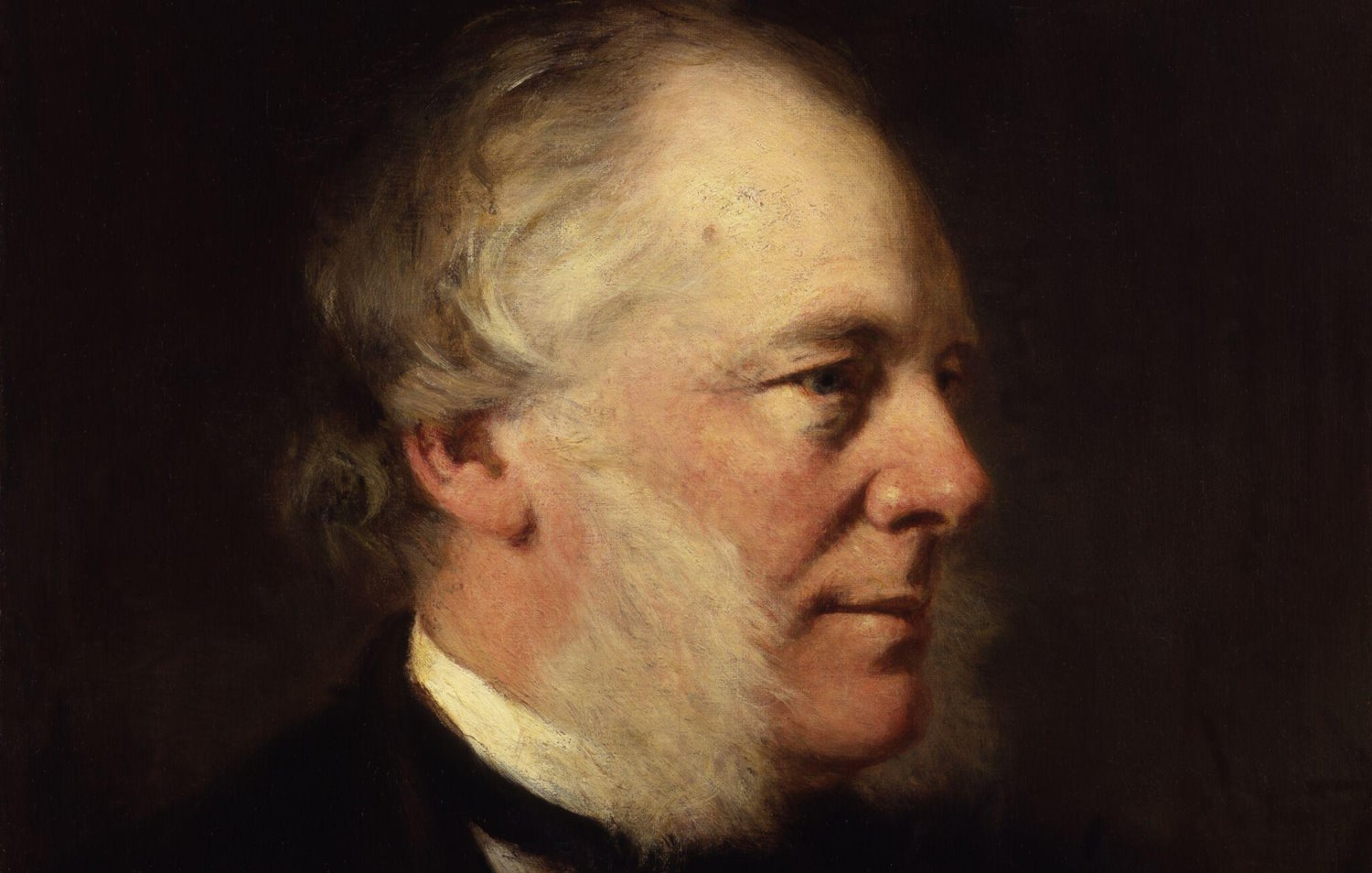

Samuel Smiles’s Self-Help is said to have reflected the spirit of its age. It also proved to be a best seller – with more than a quarter of a million copies sold by the time of Smiles’s death. Arguing for the importance of character, thrift and perseverance, the book also celebrates civility, independence and individuality. As such it reflects concerns and values that were central to working class efforts at self-improvement and study in the second half of the nineteenth century. Here we reproduce the first chapter.
The text below is taken from the 1866 edition of Self-Help published by John Murray, London.
For a discussion of his contribution see Samuel Smiles and self help
Image: Samuel Smiles painted by George Reid, Public domain, via Wikimedia Commons
_________________
Chapter 1 – Self-Help: National and Individual
“The worth of a State, in the long run, is the worth of the individuals composing it.”— J. S. Mill.
“We put too much faith in systems, and look too little to men.”— B. Disraeli.
“Heaven helps those who help themselves” is a well-tried maxim, embodying in a small compass the results of vast human experience. The spirit of self-help is the root of all genuine growth in the individual; and, exhibited in the lives of many, it constitutes the true source of national vigour and strength. Help from without is often enfeebling in its effects, but help from within invariably invigorates. Whatever is done for men or classes, to a certain extent takes away the stimulus and necessity of doing for themselves; and where men are subjected to over-guidance and over-government, the inevitable tendency is to render them comparatively helpless.
Even the best institutions can give a man no active help. Perhaps the most they can do is, to leave him free to develop himself and improve his individual condition. But in all times men have been prone to believe that their happiness and well-being were to be secured by means of institutions rather than by their own conduct. Hence the value of legislation as an agent in human advancement has usually been much over-estimated. To constitute the millionth part of a Legislature, by voting for one or two men once in three or five years, however conscientiously this duty may be performed, can exercise but little active influence upon any man’s life and character. Moreover, it is every day becoming more clearly understood, that the function of Government is negative and restrictive, rather than positive and active; being resolvable principally into protection—protection of life, liberty, and property. Laws, wisely administered, will secure men in the enjoyment of the fruits of their labour, whether of mind or body, at a comparatively small personal sacrifice; but no laws, however stringent, can make the idle industrious, the thriftless provident, or the drunken sober. Such reforms can only be effected by means of individual action, economy, and self-denial; by better habits, rather than by greater rights.
The Government of a nation itself is usually found to be but the reflex of the individuals composing it. The Government that is ahead of the people will inevitably be dragged down to their level, as the Government that is behind them will in the long run be dragged up. In the order of nature, the collective character of a nation will as surely find its befitting results in its law and government, as water finds its own level. The noble people will be nobly ruled, and the ignorant and corrupt ignobly. Indeed all experience serves to prove that the worth and strength of a State depend far less upon the form of its institutions than upon the character of its men. For the nation is only an aggregate of individual conditions, and civilization itself is but a question of the personal improvement of the men, women, and children of whom society is composed.
National progress is the sum of individual industry, energy, and uprightness, as national decay is of individual idleness, selfishness, and vice. What we are accustomed to decry as great social evils, will, for the most part, be found to be but the outgrowth of man’s own perverted life; and though we may endeavour to cut them down and extirpate them by means of Law, they will only spring up again with fresh luxuriance in some other form, unless the conditions of personal life and character are radically improved. If this view be correct, then it follows that the highest patriotism and philanthropy consist, not so much in altering laws and modifying institutions, as in helping and stimulating men to elevate and improve themselves by their own free and independent individual action.
It may be of comparatively little consequence how a man is governed from without, whilst everything depends upon how he governs himself from within. The greatest slave is not he who is ruled by a despot, great though that evil be, but he who is the thrall of his own moral ignorance, selfishness, and vice. Nations who are thus enslaved at heart cannot be freed by any mere changes of masters or of institutions; and so long as the fatal delusion prevails, that liberty solely depends upon and consists in government, so long will such changes, no matter at what cost they may be effected, have as little practical and lasting result as the shifting of the figures in a phantasmagoria. The solid foundations of liberty must rest upon individual character; which is also the only sure guarantee for social security and national progress. John Stuart Mill truly observes that “even despotism does not produce its worst effects so long as individuality exists under it; and whatever crushes individuality is despotism, by whatever name it be called.”
Old fallacies as to human progress are constantly turning up. Some call for Caesars, others for Nationalities, and others for Acts of Parliament. We are to wait for Caesars, and when they are found, “happy the people who recognise and follow them.” (1) This doctrine shortly means, everything for the people, nothing by them,—a doctrine which, if taken as a guide, must, by destroying the free conscience of a community, speedily prepare the way for any form of despotism. Caesarism is human idolatry in its worst form—a worship of mere power, as degrading in its effects as the worship of mere wealth would be. A far healthier doctrine to inculcate among the nations would be that of Self-Help; and so soon as it is thoroughly understood and carried into action, Caesarism will be no more. The two principles are directly antagonistic; and what Victor Hugo said of the Pen and the Sword alike applies to them, “Ceci tuera cela.” [This will kill that.]
The power of Nationalities and Acts of Parliament is also a prevalent superstition. What William Dargan, one of Ireland’s truest patriots, said at the closing of the first Dublin Industrial Exhibition, may well be quoted now. “To tell the truth,” he said, “I never heard the word independence mentioned that my own country and my own fellow townsmen did not occur to my mind. I have heard a great deal about the independence that we were to get from this, that, and the other place, and of the great expectations we were to have from persons from other countries coming amongst us. Whilst I value as much as any man the great advantages that must result to us from that intercourse, I have always been deeply impressed with the feeling that our industrial independence is dependent upon ourselves. I believe that with simple industry and careful exactness in the utilization of our energies, we never had a fairer chance nor a brighter prospect than the present. We have made a step, but perseverance is the great agent of success; and if we but go on zealously, I believe in my conscience that in a short period we shall arrive at a position of equal comfort, of equal happiness, and of equal independence, with that of any other people.”
All nations have been made what they are by the thinking and the working of many generations of men. Patient and persevering labourers in all ranks and conditions of life, cultivators of the soil and explorers of the mine, inventors and discoverers, manufacturers, mechanics and artisans, poets, philosophers, and politicians, all have contributed towards the grand result, one generation building upon another’s labours, and carrying them forward to still higher stages. This constant succession of noble workers—the artisans of civilisation—has served to create order out of chaos in industry, science, and art; and the living race has thus, in the course of nature, become the inheritor of the rich estate provided by the skill and industry of our forefathers, which is placed in our hands to cultivate, and to hand down, not only unimpaired but improved, to our successors.
The spirit of self-help, as exhibited in the energetic action of individuals, has in all times been a marked feature in the English character, and furnishes the true measure of our power as a nation. Rising above the heads of the mass, there were always to be found a series of individuals distinguished beyond others, who commanded the public homage. But our progress has also been owing to multitudes of smaller and less known men. Though only the generals’ names may be remembered in the history of any great campaign, it has been in a great measure through the individual valour and heroism of the privates that victories have been won. And life, too, is “a soldiers’ battle,”—men in the ranks having in all times been amongst the greatest of workers. Many are the lives of men unwritten, which have nevertheless as powerfully influenced civilisation and progress as the more fortunate Great whose names are recorded in biography. Even the humblest person, who sets before his fellows an example of industry, sobriety, and upright honesty of purpose in life, has a present as well as a future influence upon the well-being of his country; for his life and character pass unconsciously into the lives of others, and propagate good example for all time to come.
Daily experience shows that it is energetic individualism which produces the most powerful effects upon the life and action of others, and really constitutes the best practical education. Schools, academies, and colleges, give but the merest beginnings of culture in comparison with it. Far more influential is the life-education daily given in our homes, in the streets, behind counters, in workshops, at the loom and the plough, in counting-houses and manufactories, and in the busy haunts of men. This is that finishing instruction as members of society, which Schiller designated “the education of the human race,” consisting in action, conduct, self-culture, self-control,—all that tends to discipline a man truly, and fit him for the proper performance of the duties and business of life,—a kind of education not to be learnt from books, or acquired by any amount of mere literary training. With his usual weight of words Bacon observes, that “Studies teach not their own use; but that is a wisdom without them, and above them, won by observation;” a remark that holds true of actual life, as well as of the cultivation of the intellect itself. For all experience serves to illustrate and enforce the lesson, that a man perfects himself by work more than by reading,—that it is life rather than literature, action rather than study, and character rather than biography, which tend perpetually to renovate mankind.
Biographies of great, but especially of good men, are nevertheless most instructive and useful, as helps, guides, and incentives to others. Some of the best are almost equivalent to gospels—teaching high living, high thinking, and energetic action for their own and the world’s good. The valuable examples which they furnish of the power of self-help, of patient purpose, resolute working, and steadfast integrity, issuing in the formation of truly noble and manly character, exhibit in language not to be misunderstood, what it is in the power of each to accomplish for himself; and eloquently illustrate the efficacy of self-respect and self-reliance in enabling men of even the humblest rank to work out for themselves an honourable competency and a solid reputation.
Great men of science, literature, and art—apostles of great thoughts and lords of the great heart—have belonged to no exclusive class nor rank in life. They have come alike from colleges, workshops, and farmhouses,—from the huts of poor men and the mansions of the rich. Some of God’s greatest apostles have come from “the ranks.” The poorest have sometimes taken the highest places; nor have difficulties apparently the most insuperable proved obstacles in their way. Those very difficulties, in many instances, would ever seem to have been their best helpers, by evoking their powers of labour and endurance, and stimulating into life faculties which might otherwise have lain dormant. The instances of obstacles thus surmounted, and of triumphs thus achieved, are indeed so numerous, as almost to justify the proverb that “with Will one can do anything.” Take, for instance, the remarkable fact, that from the barber’s shop came Jeremy Taylor, the most poetical of divines; Sir Richard Arkwright, the inventor of the spinning-jenny and founder of the cotton manufacture; Lord Tenterden, one of the most distinguished of Lord Chief Justices; and Turner, the greatest among landscape painters.
No one knows to a certainty what Shakespeare was; but it is unquestionable that he sprang from a humble rank. His father was a butcher and grazier; and Shakespeare himself is supposed to have been in early life a woolcomber; whilst others aver that he was an usher in a school and afterwards a scrivener’s clerk. He truly seems to have been “not one, but all mankind’s epitome.” For such is the accuracy of his sea phrases that a naval writer alleges that he must have been a sailor; whilst a clergyman infers, from internal evidence in his writings, that he was probably a parson’s clerk; and a distinguished judge of horse-flesh insists that he must have been a horse-dealer. Shakespeare was certainly an actor, and in the course of his life “played many parts,” gathering his wonderful stores of knowledge from a wide field of experience and observation. In any event, he must have been a close student and a hard worker; and to this day his writings continue to exercise a powerful influence on the formation of English character.
The common class of day labourers has given us Brindley the engineer, Cook the navigator, and Burns the poet. Masons and bricklayers can boast of Ben Jonson, who worked at the building of Lincoln’s Inn, with a trowel in his hand and a book in his pocket, Edwards and Telford the engineers, Hugh Miller the geologist, and Allan Cunningham the writer and sculptor; whilst among distinguished carpenters we find the names of Inigo Jones the architect, Harrison the chronometer-maker, John Hunter the physiologist, Romney and Opie the painters, Professor Lee the Orientalist, and John Gibson the sculptor.
From the weaver class have sprung Simson the mathematician, Bacon the sculptor, the two Milners, Adam Walker, John Foster, Wilson the ornithologist, Dr. Livingstone the missionary traveller, and Tannahill the poet. Shoemakers have given us Sir Cloudesley Shovel the great Admiral, Sturgeon the electrician, Samuel Drew the essayist, Gifford the editor of the ‘Quarterly Review,’ Bloomfield the poet, and William Carey the missionary; whilst Morrison, another laborious missionary, was a maker of shoe-lasts. Within the last few years, a profound naturalist has been discovered in the person of a shoemaker at Banff, named Thomas Edwards, who, while maintaining himself by his trade, has devoted his leisure to the study of natural science in all its branches, his researches in connexion with the smaller crustaceae having been rewarded by the discovery of a new species, to which the name of “Praniza Edwardsii” has been given by naturalists.
Nor have tailors been undistinguished. John Stow, the historian, worked at the trade during some part of his life. Jackson, the painter, made clothes until he reached manhood. The brave Sir John Hawkswood, who so greatly distinguished himself at Poictiers, and was knighted by Edward III. for his valour, was in early life apprenticed to a London tailor. Admiral Hobson, who broke the boom at Vigo in 1702, belonged to the same calling. He was working as a tailor’s apprentice near Bonchurch, in the Isle of Wight, when the news flew through the village that a squadron of men-of-war was sailing off the island. He sprang from the shopboard, and ran down with his comrades to the beach, to gaze upon the glorious sight. The boy was suddenly inflamed with the ambition to be a sailor; and springing into a boat, he rowed off to the squadron, gained the admiral’s ship, and was accepted as a volunteer. Years after, he returned to his native village full of honours, and dined off bacon and eggs in the cottage where he had worked as an apprentice. But the greatest tailor of all is unquestionably Andrew Johnson, the present President of the United States—a man of extraordinary force of character and vigour of intellect. In his great speech at Washington, when describing himself as having begun his political career as an alderman, and run through all the branches of the legislature, a voice in the crowd cried, “From a tailor up.” It was characteristic of Johnson to take the intended sarcasm in good part, and even to turn it to account. “Some gentleman says I have been a tailor. That does not disconcert me in the least; for when I was a tailor I had the reputation of being a good one, and making close fits; I was always punctual with my customers, and always did good work.”
Cardinal Wolsey, De Foe, Akenside, and Kirke White were the sons of butchers; Bunyan was a tinker, and Joseph Lancaster a basket-maker. Among the great names identified with the invention of the steam-engine are those of Newcomen, Watt, and Stephenson; the first a blacksmith, the second a maker of mathematical instruments, and the third an engine-fireman. Huntingdon the preacher was originally a coalheaver, and Bewick, the father of wood-engraving, a coalminer. Dodsley was a footman, and Holcroft a groom. Baffin the navigator began his seafaring career as a man before the mast, and Sir Cloudesley Shovel as a cabin-boy. Herschel played the oboe in a military band. Chantrey was a journeyman carver, Etty a journeyman printer, and Sir Thomas Lawrence the son of a tavern-keeper. Michael Faraday, the son of a blacksmith, was in early life apprenticed to a bookbinder, and worked at that trade until he reached his twenty-second year: he now occupies the very first rank as a philosopher, excelling even his master, Sir Humphry Davy, in the art of lucidly expounding the most difficult and abstruse points in natural science.
Among those who have given the greatest impulse to the sublime science of astronomy, we find Copernicus, the son of a Polish baker; Kepler, the son of a German public-house keeper, and himself the “garçon de cabaret;” d’Alembert, a foundling picked up one winter’s night on the steps of the church of St. Jean le Rond at Paris, and brought up by the wife of a glazier; and Newton and Laplace, the one the son of a small freeholder near Grantham, the other the son of a poor peasant of Beaumont-en-Auge, near Honfleur. Notwithstanding their comparatively adverse circumstances in early life, these distinguished men achieved a solid and enduring reputation by the exercise of their genius, which all the wealth in the world could not have purchased. The very possession of wealth might indeed have proved an obstacle greater even than the humble means to which they were born. The father of Lagrange, the astronomer and mathematician, held the office of Treasurer of War at Turin; but having ruined himself by speculations, his family were reduced to comparative poverty. To this circumstance Lagrange was in after life accustomed partly to attribute his own fame and happiness. “Had I been rich,” said he, “I should probably not have become a mathematician.”
The sons of clergymen and ministers of religion generally, have particularly distinguished themselves in our country’s history. Amongst them we find the names of Drake and Nelson, celebrated in naval heroism; of Wollaston, Young, Playfair, and Bell, in science; of Wren, Reynolds, Wilson, and Wilkie, in art; of Thurlow and Campbell, in law; and of Addison, Thomson, Goldsmith, Coleridge, and Tennyson, in literature. Lord Hardinge, Colonel Edwardes, and Major Hodson, so honourably known in Indian warfare, were also the sons of clergymen. Indeed, the empire of England in India was won and held chiefly by men of the middle class—such as Clive, Warren Hastings, and their successors—men for the most part bred in factories and trained to habits of business.
Among the sons of attorneys we find Edmund Burke, Smeaton the engineer, Scott and Wordsworth, and Lords Somers, Hardwick, and Dunning. Sir William Blackstone was the posthumous son of a silk-mercer. Lord Gifford’s father was a grocer at Dover; Lord Denman’s a physician; judge Talfourd’s a country brewer; and Lord Chief Baron Pollock’s a celebrated saddler at Charing Cross. Layard, the discoverer of the monuments of Nineveh, was an articled clerk in a London solicitor’s office; and Sir William Armstrong, the inventor of hydraulic machinery and of the Armstrong ordnance, was also trained to the law and practised for some time as an attorney. Milton was the son of a London scrivener, and Pope and Southey were the sons of linendrapers. Professor Wilson was the son of a Paisley manufacturer, and Lord Macaulay of an African merchant. Keats was a druggist, and Sir Humphry Davy a country apothecary’s apprentice. Speaking of himself, Davy once said, “What I am I have made myself: I say this without vanity, and in pure simplicity of heart.” Richard Owen, the Newton of Natural History, began life as a midshipman, and did not enter upon the line of scientific research in which he has since become so distinguished, until comparatively late in life. He laid the foundations of his great knowledge while occupied in cataloguing the magnificent museum accumulated by the industry of John Hunter, a work which occupied him at the College of Surgeons during a period of about ten years.
Foreign not less than English biography abounds in illustrations of men who have glorified the lot of poverty by their labours and their genius. In Art we find Claude, the son of a pastrycook; Geefs, of a baker; Leopold Robert, of a watchmaker; and Haydn, of a wheelwright; whilst Daguerre was a scene-painter at the Opera. The father of Gregory VII. was a carpenter; of Sextus V., a shepherd; and of Adrian VI., a poor bargeman. When a boy, Adrian, unable to pay for a light by which to study, was accustomed to prepare his lessons by the light of the lamps in the streets and the church porches, exhibiting a degree of patience and industry which were the certain forerunners of his future distinction. Of like humble origin were Hauy, the mineralogist, who was the son of a weaver of Saint-Just; Hautefeuille, the mechanician, of a baker at Orleans; Joseph Fourier, the mathematician, of a tailor at Auxerre; Durand, the architect, of a Paris shoemaker; and Gesner, the naturalist, of a skinner or worker in hides, at Zurich. This last began his career under all the disadvantages attendant on poverty, sickness, and domestic calamity; none of which, however, were sufficient to damp his courage or hinder his progress. His life was indeed an eminent illustration of the truth of the saying, that those who have most to do and are willing to work, will find the most time. Pierre Ramus was another man of like character. He was the son of poor parents in Picardy, and when a boy was employed to tend sheep. But not liking the occupation he ran away to Paris. After encountering much misery, he succeeded in entering the College of Navarre as a servant. The situation, however, opened for him the road to learning, and he shortly became one of the most distinguished men of his time.
The chemist Vauquelin was the son of a peasant of Saint-André-d’Herbetot, in the Calvados. When a boy at school, though poorly clad, he was full of bright intelligence; and the master, who taught him to read and write, when praising him for his diligence, used to say, “Go on, my boy; work, study, Colin, and one day you will go as well dressed as the parish churchwarden!” A country apothecary who visited the school, admired the robust boy’s arms, and offered to take him into his laboratory to pound his drugs, to which Vauquelin assented, in the hope of being able to continue his lessons. But the apothecary would not permit him to spend any part of his time in learning; and on ascertaining this, the youth immediately determined to quit his service. He therefore left Saint-André and took the road for Paris with his havresac on his back. Arrived there, he searched for a place as apothecary’s boy, but could not find one. Worn out by fatigue and destitution, Vauquelin fell ill, and in that state was taken to the hospital, where he thought he should die. But better things were in store for the poor boy. He recovered, and again proceeded in his search of employment, which he at length found with an apothecary. Shortly after, he became known to Fourcroy the eminent chemist, who was so pleased with the youth that he made him his private secretary; and many years after, on the death of that great philosopher, Vauquelin succeeded him as Professor of Chemistry. Finally, in 1829, the electors of the district of Calvados appointed him their representative in the Chamber of Deputies, and he re-entered in triumph the village which he had left so many years before, so poor and so obscure.
England has no parallel instances to show, of promotions from the ranks of the army to the highest military offices; which have been so common in France since the first Revolution. “La carrière ouverte aux talents” has there received many striking illustrations, which would doubtless be matched among ourselves were the road to promotion as open. Hoche, Humbert, and Pichegru, began their respective careers as private soldiers. Hoche, while in the King’s army, was accustomed to embroider waistcoats to enable him to earn money wherewith to purchase books on military science. Humbert was a scapegrace when a youth; at sixteen he ran away from home, and was by turns servant to a tradesman at Nancy, a workman at Lyons, and a hawker of rabbit skins. In 1792, he enlisted as a volunteer; and in a year he was general of brigade. Kleber, Lefèvre, Suchet, Victor, Lannes, Soult, Massena, St. Cyr, D’Erlon, Murat, Augereau, Bessières, and Ney, all rose from the ranks. In some cases promotion was rapid, in others it was slow. Saint Cyr, the son of a tanner of Toul, began life as an actor, after which he enlisted in the Chasseurs, and was promoted to a captaincy within a year. Victor, Duc de Belluno, enlisted in the Artillery in 1781: during the events preceding the Revolution he was discharged; but immediately on the outbreak of war he re-enlisted, and in the course of a few months his intrepidity and ability secured his promotion as Adjutant-Major and chief of battalion. Murat, “le beau sabreur,” was the son of a village innkeeper in Perigord, where he looked after the horses. He first enlisted in a regiment of Chasseurs, from which he was dismissed for insubordination: but again enlisting, he shortly rose to the rank of Colonel. Ney enlisted at eighteen in a hussar regiment, and gradually advanced step by step: Kleber soon discovered his merits, surnaming him “The Indefatigable,” and promoted him to be Adjutant-General when only twenty-five. On the other hand, Soult (2) was six years from the date of his enlistment before he reached the rank of sergeant. But Soult’s advancement was rapid compared with that of Massena, who served for fourteen years before he was made sergeant; and though he afterwards rose successively, step by step, to the grades of Colonel, General of Division, and Marshal, he declared that the post of sergeant was the step which of all others had cost him the most labour to win. Similar promotions from the ranks, in the French army, have continued down to our own day. Changarnier entered the King’s bodyguard as a private in 1815. Marshal Bugeaud served four years in the ranks, after which he was made an officer. Marshal Randon, the present French Minister of War, began his military career as a drummer boy; and in the portrait of him in the gallery at Versailles, his hand rests upon a drum-head, the picture being thus painted at his own request. Instances such as these inspire French soldiers with enthusiasm for their service, as each private feels that he may possibly carry the baton of a marshal in his knapsack.
The instances of men, in this and other countries, who, by dint of persevering application and energy, have raised themselves from the humblest ranks of industry to eminent positions of usefulness and influence in society, are indeed so numerous that they have long ceased to be regarded as exceptional. Looking at some of the more remarkable, it might almost be said that early encounter with difficulty and adverse circumstances was the necessary and indispensable condition of success. The British House of Commons has always contained a considerable number of such self-raised men—fitting representatives of the industrial character of the people; and it is to the credit of our Legislature that they have been welcomed and honoured there. When the late Joseph Brotherton, member for Salford, in the course of the discussion on the Ten Hours Bill, detailed with true pathos the hardships and fatigues to which he had been subjected when working as a factory boy in a cotton mill, and described the resolution which he had then formed, that if ever it was in his power he would endeavour to ameliorate the condition of that class, Sir James Graham rose immediately after him, and declared, amidst the cheers of the House, that he did not before know that Mr. Brotherton’s origin had been so humble, but that it rendered him more proud than he had ever before been of the House of Commons, to think that a person risen from that condition should be able to sit side by side, on equal terms, with the hereditary gentry of the land.
The late Mr. Fox, member for Oldham, was accustomed to introduce his recollections of past times with the words, “when I was working as a weaver boy at Norwich;” and there are other members of parliament, still living, whose origin has been equally humble. Mr. Lindsay, the well-known ship owner, until recently member for Sunderland, once told the simple story of his life to the electors of Weymouth, in answer to an attack made upon him by his political opponents. He had been left an orphan at fourteen, and when he left Glasgow for Liverpool to push his way in the world, not being able to pay the usual fare, the captain of the steamer agreed to take his labour in exchange, and the boy worked his passage by trimming the coals in the coal hole. At Liverpool he remained for seven weeks before he could obtain employment, during which time he lived in sheds and fared hardly; until at last he found shelter on board a West Indiaman. He entered as a boy, and before he was nineteen, by steady good conduct he had risen to the command of a ship. At twenty-three he retired from the sea, and settled on shore, after which his progress was rapid “he had prospered,” he said, “by steady industry, by constant work, and by ever keeping in view the great principle of doing to others as you would be done by.”
The career of Mr. William Jackson, of Birkenhead, the present member for North Derbyshire, bears considerable resemblance to that of Mr. Lindsay. His father, a surgeon at Lancaster, died, leaving a family of eleven children, of whom William Jackson was the seventh son. The elder boys had been well educated while the father lived, but at his death the younger members had to shift for themselves. William, when under twelve years old, was taken from school, and put to hard work at a ship’s side from six in the morning till nine at night. His master falling ill, the boy was taken into the counting-house, where he had more leisure. This gave him an opportunity of reading, and having obtained access to a set of the ‘encyclopedia Britannica,’ he read the volumes through from A to Z, partly by day, but chiefly at night. He afterwards put himself to a trade, was diligent, and succeeded in it. Now he has ships sailing on almost every sea, and holds commercial relations with nearly every country on the globe.
Among like men of the same class may be ranked the late Richard Cobden, whose start in life was equally humble. The son of a small farmer at Midhurst in Sussex, he was sent at an early age to London and employed as a boy in a warehouse in the City. He was diligent, well conducted, and eager for information. His master, a man of the old school, warned him against too much reading; but the boy went on in his own course, storing his mind with the wealth found in books. He was promoted from one position of trust to another—became a traveller for his house—secured a large connection, and eventually started in business as a calico printer at Manchester. Taking an interest in public questions, more especially in popular education, his attention was gradually drawn to the subject of the Corn Laws, to the repeal of which he may be said to have devoted his fortune and his life. It may be mentioned as a curious fact that the first speech he delivered in public was a total failure. But he had great perseverance, application, and energy; and with persistency and practice, he became at length one of the most persuasive and effective of public speakers, extorting the disinterested eulogy of even Sir Robert Peel himself. M. Drouyn de Lhuys, the French Ambassador, has eloquently said of Mr. Cobden, that he was “a living proof of what merit, perseverance, and labour can accomplish; one of the most complete examples of those men who, sprung from the humblest ranks of society, raise themselves to the highest rank in public estimation by the effect of their own worth and of their personal services; finally, one of the rarest examples of the solid qualities inherent in the English character.”
In all these cases, strenuous individual application was the price paid for distinction; excellence of any sort being invariably placed beyond the reach of indolence. It is the diligent hand and head alone that maketh rich—in self-culture, growth in wisdom, and in business. Even when men are born to wealth and high social position, any solid reputation which they may individually achieve can only be attained by energetic application; for though an inheritance of acres may be bequeathed, an inheritance of knowledge and wisdom cannot. The wealthy man may pay others for doing his work for him, but it is impossible to get his thinking done for him by another, or to purchase any kind of self-culture. Indeed, the doctrine that excellence in any pursuit is only to be achieved by laborious application, holds as true in the case of the man of wealth as in that of Drew and Gifford, whose only school was a cobbler’s stall, or Hugh Miller, whose only college was a Cromarty stone quarry.
Riches and ease, it is perfectly clear, are not necessary for man’s highest culture, else had not the world been so largely indebted in all times to those who have sprung from the humbler ranks. An easy and luxurious existence does not train men to effort or encounter with difficulty; nor does it awaken that consciousness of power which is so necessary for energetic and effective action in life. Indeed, so far from poverty being a misfortune, it may, by vigorous self-help, be converted even into a blessing; rousing a man to that struggle with the world in which, though some may purchase ease by degradation, the right-minded and true-hearted find strength, confidence, and triumph. Bacon says, “Men seem neither to understand their riches nor their strength: of the former they believe greater things than they should; of the latter much less. Self-reliance and self-denial will teach a man to drink out of his own cistern, and eat his own sweet bread, and to learn and labour truly to get his living, and carefully to expend the good things committed to his trust.”
Riches are so great a temptation to ease and self-indulgence, to which men are by nature prone, that the glory is all the greater of those who, born to ample fortunes, nevertheless take an active part in the work of their generation—who “scorn delights and live laborious days.” It is to the honour of the wealthier ranks in this country that they are not idlers; for they do their fair share of the work of the state, and usually take more than their fair share of its dangers. It was a fine thing said of a subaltern officer in the Peninsular campaigns, observed trudging alone through mud and mire by the side of his regiment, “There goes 15,000l. a year!” and in our own day, the bleak slopes of Sebastopol and the burning soil of India have borne witness to the like noble self-denial and devotion on the part of our gentler classes; many a gallant and noble fellow, of rank and estate, having risked his life, or lost it, in one or other of those fields of action, in the service of his country.
Nor have the wealthier classes been undistinguished in the more peaceful pursuits of philosophy and science. Take, for instance, the great names of Bacon, the father of modern philosophy, and of Worcester, Boyle, Cavendish, Talbot, and Rosse, in science. The last named may be regarded as the great mechanic of the peerage; a man who, if he had not been born a peer, would probably have taken the highest rank as an inventor. So thorough is his knowledge of smith-work that he is said to have been pressed on one occasion to accept the foremanship of a large workshop, by a manufacturer to whom his rank was unknown. The great Rosse telescope, of his own fabrication, is certainly the most extraordinary instrument of the kind that has yet been constructed.
But it is principally in the departments of politics and literature that we find the most energetic labourers amongst our higher classes. Success in these lines of action, as in all others, can only be achieved through industry, practice, and study; and the great Minister, or parliamentary leader, must necessarily be amongst the very hardest of workers. Such was Palmerston; and such are Derby and Russell, Disraeli and Gladstone. These men have had the benefit of no Ten Hours Bill, but have often, during the busy season of Parliament, worked “double shift,” almost day and night. One of the most illustrious of such workers in modern times was unquestionably the late Sir Robert Peel. He possessed in an extraordinary degree the power of continuous intellectual labour, nor did he spare himself. His career, indeed, presented a remarkable example of how much a man of comparatively moderate powers can accomplish by means of assiduous application and indefatigable industry. During the forty years that he held a seat in Parliament, his labours were prodigious. He was a most conscientious man, and whatever he undertook to do, he did thoroughly. All his speeches bear evidence of his careful study of everything that had been spoken or written on the subject under consideration. He was elaborate almost to excess; and spared no pains to adapt himself to the various capacities of his audience. Withal, he possessed much practical sagacity, great strength of purpose, and power to direct the issues of action with steady hand and eye. In one respect he surpassed most men: his principles broadened and enlarged with time; and age, instead of contracting, only served to mellow and ripen his nature. To the last he continued open to the reception of new views, and, though many thought him cautious to excess, he did not allow himself to fall into that indiscriminating admiration of the past, which is the palsy of many minds similarly educated, and renders the old age of many nothing but a pity.
The indefatigable industry of Lord Brougham has become almost proverbial. His public labours have extended over a period of upwards of sixty years, during which he has ranged over many fields—of law, literature, politics, and science,—and achieved distinction in them all. How he contrived it, has been to many a mystery. Once, when Sir Samuel Romilly was requested to undertake some new work, he excused himself by saying that he had no time; “but,” he added, “go with it to that fellow Brougham, he seems to have time for everything.” The secret of it was, that he never left a minute unemployed; withal he possessed a constitution of iron. When arrived at an age at which most men would have retired from the world to enjoy their hard-earned leisure, perhaps to doze away their time in an easy chair, Lord Brougham commenced and prosecuted a series of elaborate investigations as to the laws of Light, and he submitted the results to the most scientific audiences that Paris and London could muster. About the same time, he was passing through the press his admirable sketches of the ‘Men of Science and Literature of the Reign of George III.,’ and taking his full share of the law business and the political discussions in the House of Lords. Sydney Smith once recommended him to confine himself to only the transaction of so much business as three strong men could get through. But such was Brougham’s love of work—long become a habit—that no amount of application seems to have been too great for him; and such was his love of excellence, that it has been said of him that if his station in life had been only that of a shoe-black, he would never have rested satisfied until he had become the best shoe-black in England.
Another hard-working man of the same class is Sir E. Bulwer Lytton. Few writers have done more, or achieved higher distinction in various walks—as a novelist, poet, dramatist, historian, essayist, orator, and politician. He has worked his way step by step, disdainful of ease, and animated throughout by the ardent desire to excel. On the score of mere industry, there are few living English writers who have written so much, and none that have produced so much of high quality. The industry of Bulwer is entitled to all the greater praise that it has been entirely self-imposed. To hunt, and shoot, and live at ease,—to frequent the clubs and enjoy the opera, with the variety of London visiting and sight-seeing during the “season,” and then off to the country mansion, with its well-stocked preserves, and its thousand delightful out-door pleasures,—to travel abroad, to Paris, Vienna, or Rome,—all this is excessively attractive to a lover of pleasure and a man of fortune, and by no means calculated to make him voluntarily undertake continuous labour of any kind. Yet these pleasures, all within his reach, Bulwer must, as compared with men born to similar estate, have denied himself in assuming the position and pursuing the career of a literary man. Like Byron, his first effort was poetical (‘Weeds and Wild Flowers’), and a failure. His second was a novel (‘Falkland’), and it proved a failure too. A man of weaker nerve would have dropped authorship; but Bulwer had pluck and perseverance; and he worked on, determined to succeed. He was incessantly industrious, read extensively, and from failure went courageously onwards to success. ‘Pelham’ followed ‘Falkland’ within a year, and the remainder of Bulwer’s literary life, now extending over a period of thirty years, has been a succession of triumphs.
Mr. Disraeli affords a similar instance of the power of industry and application in working out an eminent public career. His first achievements were, like Bulwer’s, in literature; and he reached success only through a succession of failures. His ‘Wondrous Tale of Alroy’ and ‘Revolutionary Epic’ were laughed at, and regarded as indications of literary lunacy. But he worked on in other directions, and his ‘Coningsby,’ ‘Sybil,’ and ‘Tancred,’ proved the sterling stuff of which he was made. As an orator too, his first appearance in the House of Commons was a failure. It was spoken of as “more screaming than an Adelphi farce.” Though composed in a grand and ambitious strain, every sentence was hailed with “loud laughter.” ‘Hamlet’ played as a comedy were nothing to it. But he concluded with a sentence which embodied a prophecy. Writhing under the laughter with which his studied eloquence had been received, he exclaimed, “I have begun several times many things, and have succeeded in them at last. I shall sit down now, but the time will come when you will hear me.” The time did come; and how Disraeli succeeded in at length commanding the attention of the first assembly of gentlemen in the world, affords a striking illustration of what energy and determination will do; for Disraeli earned his position by dint of patient industry. He did not, as many young men do, having once failed, retire dejected, to mope and whine in a corner, but diligently set himself to work. He carefully unlearnt his faults, studied the character of his audience, practised sedulously the art of speech, and industriously filled his mind with the elements of parliamentary knowledge. He worked patiently for success; and it came, but slowly: then the House laughed with him, instead of at him. The recollection of his early failure was effaced, and by general consent he was at length admitted to be one of the most finished and effective of parliamentary speakers.
Although much may be accomplished by means of individual industry and energy, as these and other instances set forth in the following pages serve to illustrate, it must at the same time be acknowledged that the help which we derive from others in the journey of life is of very great importance. The poet Wordsworth has well said that “these two things, contradictory though they may seem, must go together—manly dependence and manly independence, manly reliance and manly self-reliance.” From infancy to old age, all are more or less indebted to others for nurture and culture; and the best and strongest are usually found the readiest to acknowledge such help. Take, for example, the career of the late Alexis de Tocqueville, a man doubly well-born, for his father was a distinguished peer of France, and his mother a grand-daughter of Malesherbes. Through powerful family influence, he was appointed Judge Auditor at Versailles when only twenty-one; but probably feeling that he had not fairly won the position by merit, he determined to give it up and owe his future advancement in life to himself alone. “A foolish resolution,” some will say; but De Tocqueville bravely acted it out. He resigned his appointment, and made arrangements to leave France for the purpose of travelling through the United States, the results of which were published in his great book on ‘Democracy in America.’ His friend and travelling companion, Gustave de Beaumont, has described his indefatigable industry during this journey. “His nature,” he says, “was wholly averse to idleness, and whether he was travelling or resting, his mind was always at work. . . . With Alexis, the most agreeable conversation was that which was the most useful. The worst day was the lost day, or the day ill spent; the least loss of time annoyed him.” Tocqueville himself wrote to a friend—“There is no time of life at which one can wholly cease from action, for effort without one’s self, and still more effort within, is equally necessary, if not more so, when we grow old, as it is in youth. I compare man in this world to a traveller journeying without ceasing towards a colder and colder region; the higher he goes, the faster he ought to walk. The great malady of the soul is cold. And in resisting this formidable evil, one needs not only to be sustained by the action of a mind employed, but also by contact with one’s fellows in the business of life.” (3)
Notwithstanding de Tocqueville’s decided views as to the necessity of exercising individual energy and self-dependence, no one could be more ready than he was to recognise the value of that help and support for which all men are indebted to others in a greater or less degree. Thus, he often acknowledged, with gratitude, his obligations to his friends De Kergorlay and Stofells,—to the former for intellectual assistance, and to the latter for moral support and sympathy. To De Kergorlay he wrote—“Thine is the only soul in which I have confidence, and whose influence exercises a genuine effect upon my own. Many others have influence upon the details of my actions, but no one has so much influence as thou on the origination of fundamental ideas, and of those principles which are the rule of conduct.” De Tocqueville was not less ready to confess the great obligations which he owed to his wife, Marie, for the preservation of that temper and frame of mind which enabled him to prosecute his studies with success. He believed that a noble-minded woman insensibly elevated the character of her husband, while one of a grovelling nature as certainly tended to degrade it. (4)
(1) In fine, human character is moulded by a thousand subtle influences; by example and precept; by life and literature; by friends and neighbours; by the world we live in as well as by the spirits of our forefathers, whose legacy of good words and deeds we inherit. But great, unquestionably, though these influences are acknowledged to be, it is nevertheless equally clear that men must necessarily be the active agents of their own well-being and well-doing; and that, however much the wise and the good may owe to others, they themselves must in the very nature of things be their own best helpers.
Napoleon III., ‘Life of Caesar.’
(2) Soult received but little education in his youth, and learnt next to no geography until he became foreign minister of France, when the study of this branch of knowledge is said to have given him the greatest pleasure.—‘OEuvres, &c., d’Alexis de Tocqueville. Par G. de Beaumont.’ Paris, 1861. I. 52
(3) ‘OEuvres et Correspondance inédite d’Alexis de Tocqueville. Par Gustave de Beaumont.’ I. 398.
(4) “I have seen,” said he, “a hundred times in the course of my life, a weak man exhibit genuine public virtue, because supported by a wife who sustained hint in his course, not so much by advising him to such and such acts, as by exercising a strengthening influence over the manner in which duty or even ambition was to be regarded. Much oftener, however, it must be confessed, have I seen private and domestic life gradually transform a man to whom nature had given generosity, disinterestedness, and even some capacity for greatness, into an ambitious, mean-spirited, vulgar, and selfish creature who, in matters relating to his country, ended by considering them only in so far as they rendered his own particular condition more comfortable and easy.”—‘OEuvres de Tocqueville.’ II. 349.
References (introduction)
Briggs, Asa (1958) ‘Self-Help. A centenary introduction’ in Samuel Smiles (1958) Self-Help. The art of achievement illustrated by accounts of the lives of great men. London: John Murray.
Jarvis, Adrian (1997). Samuel Smiles and the Construction of Victorian Values. Thrupp: Sutton Publishing.
Matthew, H. C. G. (2004) ‘Smiles, Samuel (1812–1904)’, Oxford Dictionary of National Biography, Oxford University Press; online edn, May 2009 [http://www.oxforddnb.com/view/article/36125, accessed 7 July 2009].
Sinnema, Peter (2002) ‘Introduction’ to Samuel Smiles Self Help. Oxford: University of Oxford Press.
Smiles, Samuel (1857) The Life of George Stephenson, Railway Engineer. London: John Murray.
Smiles, Samuel (1859) Self-Help with Illustrations of Conduct and Perseverance. London: John Murray.
Smiles, Samuel (1861 1862) Lives of the Engineers : with an account of their principal works comprising also A history of inland communication in Britain.3 volumes. London: John Murray.
Smiles, Samuel (1867) The Huguenots: Their Settlements, Churches and Industries in England and Ireland. London: John Murray.
Smiles, Samuel (1871) Character. London: John Murray
Smiles, Samuel (1875) Thrift. London: John Murrary.
Smiles, Samuel (1880), Duty : with illustrations of courage, patience, & endurance. London: John Murray.
Smiles, Samuel (1887) Life and Labour or, characteristics of men of industry, culture and genius. London: John Murray.
Smiles, Samuel (1891) A Publisher and his Friends: Memoir and Correspondence of the Late John Murray. 2 volumes. London: John Murray.
Smiles, Samuel (1894) Josiah Wedgwood F.R.S. His personal history. London: John Murray.
Smiles, Samuel (1905) The Autobiography of Samuel Smiles, LLD, edited by T. Mackay. London: John Murray.
Link
Project Gutenberg – the project includes full texts of a number of works by Samuel Smiles.
This extract has been reproduced here on the understanding that it is not subject to any copyright restrictions, and that it is, and will remain, in the public domain.
Samuel Smiles by Sir George Reid is believed to be in the public domain because the copyright has expired and was sourced from Wikimedia Commons
First placed in the archives: July 2009.
updated: August 20, 2025