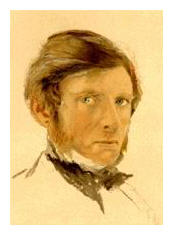
‘Modern education’ first appeared as an appendix to John Ruskin’s The Stones of Venice [Volume III] in 1853. In it he defines one of his key educational principles: education according to aptitude and circumstance.
For full discussion of John Ruskin’s educational ideas – and his approach as an educator – see: Sara E. Atwood, ‘John Ruskin on education’
[page 234] The following fragmentary notes on this subject have been set down at different times. I have been accidentally prevented from arranging them properly for publication, but there are one or two truths in them which it is better to express insufficiently than not at all.
By a large body of the people of England and of Europe a man is called educated if he can write Latin verses and construe a Greek chorus. By some few more enlightened persons it is confessed that the construction of hexameters is not in itself an important end of human existence ; but they say, that the general discipline which a course of classical reading gives to the intellectual powers, is the final object of our scholastical institutions.
But it seems to me, there is no small error even in this last and more philosophical theory. I believe, that what it is most honourable to know, it is also most profitable to learn ; and that the science which it is the highest power to possess, it is also the best exercise to acquire.
And if this be so, the question as to what should be the material of education, becomes singularly simplified. It might be matter of dispute what processes have the greatest effect in developing the intellect ; but it can hardly be disputed what facts it is most advisable that a man entering into life should accurately know.
I believe, in brief, that he ought to know three things First. Where he is. Secondly. Where he is going. Thirdly. What he had best do, under those circumstances.
First. Where he is : That is to say, what sort of a world he has got into ; how large it is ; what kind of creatures [page 235] live in it, and how ; what it is made of, and what may be made of it.
Secondly. Where he is going : That is to say, what chances or reports there are of any other world besides this ; what seems to be the nature of that other world ; and whether, for information respecting it, he had better consult the Bible, Koran, or Council of Trent.
Thirdly. What he had best do under those circumstances : That is to say, what kind of faculties he possesses ; what are the present state and wants of mankind ; what is his place in society ; and what are the readiest means in his power of attaining happiness and diffusing it. The man who knows these things, and who has had his will so subdued in the learning them, that he is ready to do what he knows he ought, I should call educated ; and the man who knows them not—uneducated, though he could talk all the tongues of Babel.
Our present European system of so-called education ignores, or despises, not one, nor the other, but all the three, of these great branches of human knowledge.
First : It despises Natural History : Until within the last year or two, the instruction in the physical sciences given at Oxford consisted of a course of twelve or fourteen lectures on the Elements of Mechanics or Pneumatics, and permission to ride out to Shotover with the Professor of Geology. I do not know the specialties of the system pursued in the academies of the Continent ; but their practical result is, that unless a man’s natural instincts urge him to the pursuit of the physical sciences too strongly to be resisted, he enters into life utterly ignorant of them. I cannot, within my present limits, even so much as count the various directions in which this ignorance does evil. But the main mischief of it is, that it leaves the greater number of men without the natural food which God intended for their intellects. For one man who is fitted for the study of words, fifty are fitted for the study of things, and were intended to have a perpetual, simple and religious delight in watching the processes, or admiring the creatures, of the natural universe. Deprived of this source of pleasure, nothing is left to them but ambition or dissipation ; and the vices of the upper classes of Europe are, I believe, chiefly to be attributed to this single cause.
Secondly : It despises Religion : I do not say it despises ‘ Theology ‘, that is to say, Talk about God. But it despises ‘ Religion ‘, that is to say, the ‘ binding ‘ or training to God’s service. There is much talk and much teaching in all our academies, of which the effect is not to bind, but to loosen, the elements of religious faith. Of the ten or twelve young men who, at Oxford, were my especial friends, who [page 236] sat with me under the same lectures on Divinity, or were punished with me for missing lecture by being sent to evening prayers [A Mohammedan youth is punished, I believe, for such misdemeanours, by being kept away from prayers], four are now zealous Romanists—a large average out of twelve ; and while thus our own universities profess to teach Protestantism, and do not, the universities on the Continent profess to teach Romanism, and do not—sending forth only rebels and infidels. During long residence on the Continent, I do not remember meeting with above two or three young men, who either believed in revelation, or had the grace to hesitate in the assertion of their infidelity.
Whence, it seems to me, we may gather one of two things ; either that there is nothing in any European form of religion so reasonable or ascertained, as that it can be taught securely to our youth, or fastened in their minds by any rivets of proof which they shall not be able to loosen the moment they begin to think ; or else, that no means are taken to train them in such demonstrable creeds.
It seems to me the duty of a rational nation to ascertain (and to be at some pains in the matter) which of these suppositions is true ; and, if indeed no proof can be given of any supernatural fact, or Divine doctrine, stronger than a youth just out of his teens can overthrow in the first stirrings of serious thought, to confess this boldly ; to get rid of the expense of an Establishment, and the hypocrisy of a Liturgy ; to exhibit its cathedrals as curious memorials of a bygone superstition, and, abandoning all thoughts of the next world, to set itself to make the best it can of this.
But if, on the other hand, there does exist any evidence by which the probability of certain religious facts may be shown, as clearly, even, as the probabilities of things not absolutely ascertained in astronomical or geological science, let this evidence be set before all our youth so distinctly, and the facts for which it appears inculcated upon them so steadily, that although it may be possible for the evil conduct of after life to efface, or for its earnest and protracted meditation to modify, the impressions of early years, it may not be possible for our young men, the instant they emerge from their academies, to scatter themselves like a flock of wild fowl risen out of a marsh, and drift away on every irregular wind of heresy and apostasy.
Lastly : Our system of European education despises Politics : That is to say, the science of the relations and duties of men to each other. One would imagine, indeed, by a glance at the state of the world, that there was no such science. And, indeed, it is one still in its infancy.
[page 237] It implies, in its full sense, the knowledge of the operations of the virtues and vices of men upon themselves and society ; the understanding of the ranks and offices of their intellectual and bodily powers in their various adaptations to art, science, and industry ; the understanding of the proper offices of art, science, and labour themselves, as well as of the foundations of jurisprudence, and broad principles of commerce ; all this being coupled with practical knowledge of the present state and wants of mankind.
What, it will be said, and is all this to be taught to schoolboys ? No ; but the first elements of it, all that are necessary to be known by an individual in order to his acting wisely in any station of life, might be taught, not only to every school-boy, but to every peasant. The impossibility of equality among men ; the good which arises from their inequality ; the compensating circumstances in different states and fortunes ; the honourableness of every man who is worthily filling his appointed place in society, however humble ; the proper relations of poor and rich, governor and governed ; the nature of wealth, and mode of its circulation ; the difference between productive and unproductive labour ; the relation of the products of the mind and hand ; the true value of works of the higher arts, and the possible amount of their production ; the meaning of ‘ Civilization ‘, its advantages and dangers ; the meaning of the term ‘ Refinement ‘ ; the possibilities of possessing refinement in a low station, and of losing it in a high one ; and, above all, the significance of almost every act of a man’s daily life, in its ultimate operation upon himself and others—all this might be, and ought to be, taught to every boy in the kingdom, so completely, that it should be just as impossible to introduce an absurd or licentious doctrine among our adult population, as a new version of the multiplication table. Nor am I altogether without hope that some day it may enter into the heads of the tutors of our schools to try whether it is not as easy to make an Eton boy’s mind as sensitive to falseness in policy, as his ear is at present to falseness in prosody.
I know that this is much to hope. That English ministers of religion should ever come to desire rather to make a youth acquainted with the powers of Nature and of God, than with the powers of Greek particles ; that they should ever think it more useful to show him how the great universe rolls upon its course in heaven, than how the syllables are fitted in a tragic metre ; that they should hold it more advisable for him to be fixed in the principles of religion than in those of syntax ; or, finally, that they should ever come to apprehend that a youth likely to go straight out of college into Parliament, might not unadvisably know [page 238] as much of the Peninsular as of the Peloponnesian War,, and be as well acquainted with the state of modern Italy as of old Etruria—all this, however unreasonably, I do hope, and mean to work for. For though I have not yet abandoned all expectation of a better world than this, I believe this in which we live is not so good as it might be. I know there are many people who suppose French revolutions, Italian insurrections, Caffre wars, and such other scenic effects of modern policy, to be among the normal conditions of humanity. I know there are many who think the atmosphere of rapine, rebellion, and misery which wraps the lower orders of Europe more closely every day, is as natural a phenomenon as a hot summer. But God forbid ! There are ills which flesh is heir to, and troubles to which man is born ; but the troubles which he is born to are as sparks which fly upward, not as flames burning to the nethermost Hell. The Poor we must have with us always, and sorrow is inseparable from any hour of life ; but we may make their poverty such as shall inherit the earth, and the sorrow, such as shall be hallowed by the hand of the Comforter, with everlasting comfort. We can, if we will but shake off this lethargy and dreaming that is upon us, and take the pains to think and act like men, we can, I say, make kingdoms to be like well-governed households, in which, indeed, while no care or kindness can prevent occasional heart-burnings, nor any foresight or piety anticipate all the vicissitudes of fortune, or avert every stroke of calamity, yet the unity of their affection and fellowship remains unbroken, and their distress is neither embittered by division, prolonged by impudence, nor darkened by dishonour.
* * * * *
The great leading error of modern times is the mistaking erudition for education. I call it the leading error, for I believe that, with little difficulty, nearly every other might be shown to have root in it ; and, most assuredly, the worst that are fallen into on the subject of art.
Education then, briefly, is the leading human souls to what is best, and making what is best out of them ; and these two objects are always attainable together, and by the same means ; the training which makes men happiest in themselves, also makes them most serviceable to others. True education, then, has respect, first to the ends which are proposable to the man, or attainable by him , and, secondly, to the material of which the man is made. So far as it is able, it chooses the end according to the material : but it cannot always choose the end, for the position of many persons in life is fixed by necessity ; still less can it choose the material ; and, therefore, all it can do, is to fit the one to the other as wisely as may be. [page 239]
But the first point to be understood, is that the material is as various as the ends ; that not only one man is unlike another, but every man is essentially different from every other, so that no training, no forming, nor informing, will ever make two persons alike in thought or in power. Among all men, whether of the upper or lower orders, the differences are eternal and irreconcilable, between one individual and another, born under absolutely the same circumstances. One man is made of agate, another of oak ; one of slate, another of clay. The education of the first is polishing ; of the second, seasoning ; of the third, rending ; of the fourth, moulding. It is of no use to season the agate ; it is vain to try to polish the slate ; but both are fitted, by the qualities they possess, for services in which they may be honoured.
Now the cry for the education of the lower classes, which is heard every day more widely and loudly, is a wise and a sacred cry, provided it be extended into one for the education of all classes, with definite respect to the work each man has to do, and the substance of which he is made. But it is a foolish and vain cry, if it be understood, as in the plurality of cases it is meant to be, for the expression of mere craving after knowledge, irrespective of the simple purposes of the life that now is, and blessings of that which is to come.
One great fallacy into which men are apt to fall when they are reasoning on this subject is : that light, as such, is always good , and darkness, as such, always evil. Far from it. Light untempered would be annihilation. It is good to them that sit in darkness and in the shadow of death ; but, to those that faint in the wilderness, so also is the shadow of the great rock in a weary land. If the sunshine is good, so also the cloud of the latter rain. Light is only beautiful, only available for life, when it is tempered with shadow ; pure light is fearful, and unendurable by humanity. And it is not less ridiculous to say that the light, as such, is good in itself, than to say that the darkness is good in itself. Both are rendered safe, healthy, and useful by the other , the night by the day, the day by the night ; and we could just as easily live without the dawn as without the sunset, so long as we are human. Of the celestial city we are told there shall be ‘ no night there ‘, and then we shall know even as also we are known : but the night and the mystery have both their service here ; and our business is not to strive to turn the night into day, but to be sure that we are as they that watch for the morning.
Therefore, in the education either of lower or upper classes, it matters not the least how much or how little they know, provided they know just what will fit them [page 240] to do their work, and to be happy in it. What the sum or the nature of their knowledge ought to be at a given time or in a given case, is a totally different question : the main thing to be understood is, that a man is not educated, in any sense whatsoever, because he can read Latin, or write English, or can behave well in a drawing-room ; but that he is is only educated if he is happy, busy, beneficent and effective in the world ; that millions of peasants are therefore at this moment better educated than most of those who call themselves gentlemen ; and that the means taken to ‘ educate ‘ the lower classes in any other sense may very often be productive of a precisely opposite result. Observe : I do not say, nor do I believe, that the lower classes ought not to be better educated, in millions of ways, than they are. I believe every man in a Christian kingdom ought to be equally well educated. But I would have it education to purpose ; stern, practical, irresistible, in moral habits, in bodily strength and beauty, in all faculties of mind capable of being developed under the circumstances of the individual, and especially in the technical knowledge of his own business ; but yet, infinitely various in its effort, directed to make one youth humble, and another confident ; to tranquillize this mind, to put some spark of ambition into that ; now to urge, and now to restrain ; and in the doing of all this, considering knowledge as one only out of myriads of means in its hands, or myriads of gifts at its disposal ; and giving it or withholding it as a good husbandman waters his garden, giving the full shower only to the thirsty plants, and at times when they are thirsty ; whereas at present we pour it upon the heads of our youth as the snow falls on the Alps, on one and another alike, till they can bear no more, and then take honour to ourselves because here and there a river descends from their crests into the valleys, not observing that we have made the loaded hills themselves barren for ever.
Finally : I hold it for indisputable, that the first duty of a state is to see that every child born therein shall be well housed, clothed, fed, and educated, till it attain years of discretion. But in order to the effecting this, the government must have an authority over the people of which we now do not so much as dream ; and I cannot in this place pursue the subject farther.
Source: John Ruskin (1853) ‘Modern education’, being Appendix 7 to The Stones of Venice. Volume III: The Fall. London. The page numbers here refer to the New Universal Library edition – George Routledge and Sons circa 1907.
This piece has been reproduced here on the understanding that it is not subject to any copyright restrictions, and that it is, and will remain, in the public domain.
https://infed.org/dir/john-ruskin-modern-education/
updated: August 20, 2025