
In this piece – which first appeared in as three articles in 1884 – William Morris sets a vision of how education and industry might be brought together under socialism.
 William Morris (1834-1896) was one of the best known Victorian poets; the ‘greatest artist craftsman of his period’, and a successful businessman (MacCarthy 1994: vii). He was also ‘a passionate social reformer, an early environmentalist, an educationalist and would-be feminist’ (op. cit.). Morris was also to become a revolutionary socialist (joining the Democractic Federation in 1883) and in this piece which was initially published as three articles in Justice – the journal of the Social Democratic Federation – between April and June in 1884 we can see his vision of the way in which industry and education might be connected in a socialist society.
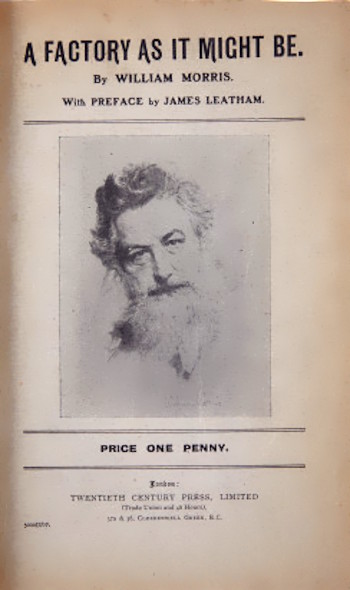
A Factory As It Might Be later appeared as a pamphlet.
[See William Morris and education in the encyclopedia]
_______________
I
We Socialists are often reproached with giving no details of the state of things which would follow on the destruction of that system of waste and war which is sometimes dignified by the lying title of the harmonious combination of capital and labour: many worthy people say, “We admit that the present system has produced unsatisfactory results, but at least it is a system; you ought to be able to give us some definite idea of the results of that reconstruction which you call Socialism.”
To this Socialists answer, and rightly, that we have not set ourselves to build up a system to please our tastes; nor are we seeking to impose it on the world in a mechanical manner, but that we are assisting in bringing about a development of history which would take place without our help, but which nevertheless compels us to help it: and that under these circumstances it would be futile to map out the details of life in a condition of things so different from that in which we have been born and bred. Those details will be taken care of by the men who will be so lucky as to be born into a society relieved of the oppression which crushes us, and who surely will be, not less, but more prudent and reasonable than we are. Nevertheless it seems clear that the economical changes which are in progress must be accompanied by corresponding developments of men’s aspirations; and the knowledge of their progress cannot fail to rouse our imaginations into picturing for ourselves that life at once happy and manly which we know social revolution will put within the reach of all men.
Of course the pictures so drawn will vary according to the turn of mind of the picturer, but I have already tried to show in Justice that healthy and undomineering individuality will be fostered and not crushed out by Socialism. I will therefore as an artist and handicraftsman venture to develop a little the hint contained in this journal of April 12th on the conditions of pleasant work in the days when we shall work for livelihood and pleasure and not for “profit”.
Our factory then, is in a pleasant place: no very difficult matter, when as I have said before it is no longer necessary to gather people into able sweltering hordes for profit’s sake: for all the country is in itself pleasant or is capable of being made pleasant with very little pains and forethought. Next, our factory stands amidst gardens as beautiful (climate apart) as those of Alcinous, since there is no need of stinting it of ground, profit rents being a thing of the past and the labour on such gardens is like enough to be purely voluntary, as it is not easy to see the day when 75 out every 100 people will not take delight in the pleasantest and most innocent of all occupations; and our working people will assuredly want open air relaxation from their factory work. Even now, as I am told, the Nottingham factory hands could give many a hint to professional gardeners in spite of all the drawbacks of a great manufacturing town. One’s imagination is inclined fairly to run riot over the picture of beauty and pleasure offered by the thought of skilful co-operative gardening for beauty’s sake, which beauty would by no means exclude the raising of useful produce for the sake of livelihood. [One thinks of Bourneville, but not a Bourneville for every manufacturing city].
Impossible! I hear an anti-Socialist say. My friend, please to remember that most factories sustain to-day large and handsome gardens, and not seldom parks and woods of many acres in extent; with due appurtenances of highly paid Scotch professional gardeners, wood reeves, bailiffs, game-keepers, and the like, the whole being managed in the most wasteful way conceivable: only, the said gardens, &c., are say, twenty miles away from the factory, out of the smoke, and are kept up for one member of the factory only, the sleeping partner to wit, who in may, indeed double that part by organizing its labour (for his own profit) in which case he receives ridiculously disproportionate pay additional.
Well, it follows on this garden business that our factory must make no sordid litter, befoul no water, nor poison the air with smoke. I need say nothing more on that point, as “profit” apart it would be easy enough.
Next, as to the buildings themselves I must ask leave to say something, because it is usually supposed that they must of necessity be ugly, and truly they are almost always at present mere night-mares; but it is, I must assert, by no means necessary that they should be ugly, nay, there would be no serious difficulty in making them beautiful, as every building might be which serves its purpose duly, which is built generously as regards material, and which is built with pleasure by the builders and designers; indeed, as things go, those nightmare buildings aforesaid sufficiently typify the work they are built for, and lack what they are, temples of overcrowding and adulteration and over-work, of unrest in a word; so it is not difficult to think of our factory buildings showing on their outsides what they are for, reasonable and light work, cheered at every step by hope and pleasure. So in brief, our buildings will be beautiful with their own beauty of simplicity as workshops, not bedizened with tomfoolery as some are now which do not any the more for that hide their repulsiveness; but moreover besides the mere workshops, our factory will have other buildings which may carry ornament further than that, will for it will need dining hall, library, school, places for study of various kinds, and other such structures; nor do I see why, if we have a mind for it, we should not emulate the monks and craftsmen of the middle ages in our ornamentation of such buildings, why we should be shabby in housing our rest and pleasure and our search for knowledge, as we may well be shabby in housing the shabby life we have to live now?
Add again, if it be doubted as to the possibility of getting these beautiful buildings on the score of cost; let me once again remind you that every great factory does to-day sustain a palace (often more than one) amidst that costly garden and park aforesaid out of the smoke, but that this palace, stuffed as it is with all sorts of costly things, is for one member of the factory only, the sleeping partner – useful creature! It is true that the said palace is mostly, with all it contains, beastly ugly; but this ugliness is but apart of the bestial waste of the whole system of profit-mongering, which refuses cultivation and refinement to the workers, and therefore can have no art, not even for all its money.
So we have come to the outside of our Factory of the future and seen that it does not injure the beauty of the world, but adds to it rather; on another occasion, if I may I will try to give a picture of how the work goes on there.
II
In a recent article we tried to look through the present into the future and see a factory as it might be, and got as far as the surroundings outside of it; but those externals of a true palace of industry can be only realised, naturally and without affectation by the work which is to be done in them being in all ways reasonable and fit for human beings; I mean no mere whim of some one rich and philanthropic manufacturer will make even one factory permanently pleasant and agreeable for the workers in it; he will die or be sold up, his heir will be poorer or more single-hearted in his devotion to profit, and all the beauty and order will vanish from the short-lived dream: even the external beauty in industrial concerns must be the work of society and not of individuals.
Now as to the work, first of all it will be useful and therefore honourable and honoured; because there will be no temptation to make mere useless toys, since there will be no rich men cudgelling their brains for means for spending superfluous money and consequently no “organisers of labour” pandering to degrading follies for the sake of profit, wasting their intelligence and energy to contriving snares for cash in the shape of trumpery, which they themselves heartily despise. Nor will the work turn out trash; there will be no millions of poor to make a market for wares which no one would choose to use if he were not driven to do so; everyone will be able to afford things good of their kind and as will be shown thereafter, will have knowledge of goods enough to reject what is not excellent; coarse and rough wares may he made for rough or temporary purposes, but they will openly proclaim themselves for what they are; adulteration will be unknown.
Furthermore machines of the most ingenious and best approved kinds will be used when necessary, but will be used simply to save human labour; nor indeed could they be used for anything else, in such well-ordered work as we are thinking about; since, profit being dead, there would be no temptation to pile up wares whose apparent value as articles of use, their conventional value as such, does not rest on the necessities or reasonable desires of men for such things, but on artificial habits forced on the public by the craving of the capitalists for fresh and ever fresh profit: those things have no real value as things to be used, and their conventional (let us say sham) utility value has been bred of their value as articles of exchange for profit, in a society founded on profit mongering.
Well the manufacture of useless goods, whether harmful luxuries for the rich or disgraceful makeshifts for the poor have come to an end, and we still being in possession of the machines once used for mere profit grinding but now used only for saving human labour, it follows that much less labour will be necessary for each workman; all the more as we are going to get rid of all non-workers, and busy-idle people; so that the working time of each member of our factory will be very short, say, to be much within the mark, four hours a day.
Now it may be allowable for an artist, that is one whose ordinary work is pleasant and not slavish, to hope that in no factory will all the work, even that necessary four hours work, be mere machine-tending; and it follows from what was said above about machines being used to save labour, that there would be no work which would turn men into mere machines; therefore at least some portion of the work, the necessary and in fact compulsory work I mean, would be pleasant to do; the machine-tending ought not to require a very long apprenticeship, therefore is no case should any one person be set to run up and down after a machine through all his waking hours everyday, even so shortened as we have seen; now the attractive work of our factory, that which was pleasant in itself to do, would be of the nature of art: therefore all slavery of work ceases under such a system, for whatever is burdensome about the factory would be taken turn and turn about and so distributed would cease to be a burden, would be in fact a kind of rest from the more exciting or artistic work.
Thus then would the sting be taken out of the factory system ; in which as things now are the socialisation of labour which ought to have been a blessing to the community has been turned into a curse by the appropriation of the products of its labour by individuals, for the purpose of gaining for them the very doubtful advantages of a life of special luxury and often of mere idleness; the result of which to the mass of the workers has been a dire slavery, of which long hours of labour, ever increasing strain of labour during those hours, and complete repulsiveness in the work itself have been the greatest evils.
It remains for me in another article to set forth my hopes of the way in which the gathering together of people in such social bodies as properly ordered factories might be may be utilised or increasing the general pleasure and raising its standard material and intellectual for creating in short that life rich in incident and variety, but free from the strain of mere sordid trouble, the life which the individualist vainly babbles of but which the Socialist aims at directly and will one day attain to.
III
I have tried to show in former articles that in a duly ordered society, in which people would work for a livelihood and not for the profit of another, a factory might not only be pleasant as to its surroundings, and beautiful in its architecture, but that even the rough and necessary work done in it might be so arranged as to be neither burdensome in itself or of long duration for each worker; but furthermore the organization of such a factory, that is to say of a group of people working in harmonious cooperation towards a useful end, would of itself afford opportunities for increasing the pleasure of life.
To begin with such a factory will surely be a centre of education: any children who seem likely to develop gifts towards its special industry would gradually and without pain, amidst their book learning be drawn into technical instruction which would bring them at last into a thorough apprenticeship for their craft; therefore, the bent of each child having been considered in choosing its instruction and occupation, it is not too much to expect that children so educated will look forward eagerly to the time when they will be allowed to work at turning out real useful wares; a child whose manual dexterity has been developed without undue forcing side by side with its mental intelligence would surely be as eager to handle shuttle, hammer, or what not for the first time as a real workman, and begin making, as a young gentleman now is to get hold of his first gun and begin killing.
This education so begun for the child will continue for the grown man, who will have every opportunity to practice the niceties of his craft, if he be so minded, to carry it to the utmost degree of perfection, not for the purpose of using his extra knowledge and skill to sweat his fellow-workman, but for his own pleasure, and honour as a good artist. Similar opportunities will be afforded him to study, as deeply as the subject will bear, the science on which his craft is founded: besides, a good library and help in studying it will be provided by every productive group (or factory), so that the worker’s other voluntary work may be varied by the study of general science or literature.
But further, the factory could supply another educational want by showing the general public how its goods are made. Competition being dead and buried, no new process, no detail of improvements in machinery, would be hidden from the first enquirer; the knowledge which might thus be imparted would foster a general interest in work and in the realities of life, which would surely tend to elevate labour and create a standard of excellence in manufacture, which in its turn would breed a strong motive towards exertion to the workers.
A strange contrast such a state of things would be to that now existing! For to-day the public, and especially that part of it which does not follow any manual occupation, is grossly ignorant of crafts and processes, even when they are carried on at their own doors: so that most of the middle class are not only defenceless against the most palpable adulterations, but also which is far more serious, are of necessity whole worlds removed from any sympathy with the life of the workshop.
So managed, therefore, the factory by co-operation with other industrial groups will both provide an education for its own workers and contribute its share to the education of citizens outside; but further, it will, as a matter of course, find it easy to provide for mere restful amusements, as it will have ample buildings for library, school-room, dining hall. and the like; social gatherings, musical or dramatic entertainments will obviously be easy to manage under such conditions.
One pleasure – and that a more serious one – I must mention: a pleasure which is unknown at present to the workers, and which even for the classes of ease and leisure only exists in a miserably corrupted and degraded form. I mean the practice of the fine arts: people living under the conditions of life above-mentioned, having manual skill, technical and general education, and leisure to use these advantages, are quite sure to develop a love of art, that is to say, a sense of beauty and an interest in life, which, in the long run must stimulate them to the desire for artistic creation, the satisfaction of which is of all pleasures the greatest.
I have started by supposing our group of social labour busying itself in the production of bodily necessaries; but we have seen that such work will only take a small part of each worker’s time: their leisure, beyond mere bodily rest and recreation, I have supposed some would employ in perfecting themselves in the niceties of their craft, or in research as to its principles; some would stop there, others would take to studying more general knowledge, but some – and I think most – would find themselves impelled towards the creation of beauty, and would find their opportunities for this under their hands as they worked out their due quota of necessary word far the common good: these would amuse themselves by ornamenting the wares they made, and would only be limited in the quantity and quality of, such work by artistic considerations as to how much or what kind of work really suited the wares: nor, to meet a possible objection, would there be any danger of such ornamental work degenerating into mere amateur twaddle, such as is now inflicted on the world by fine ladies and gentlemen in search for a refuge from boredom; because our worker will be thoroughly educated as workers and will know well what good work and true finish (not trade finish) mean, and because the public being a body of workers also, everyone in some line or other, will well understand what real work means. Our workers, therefore, will do their artistic work under keen criticism of themselves, their workshop comrades, and a public composed of intelligent workmen.
To add beauty to their necessary daily work will furnish outlet for the artistic aspirations of most men; but further, our factory which is externally beautiful, will not be inside like a clean jail or workhouse; the architecture will come inside in the form of such ornament as may be suitable to the special circumstances. Nor can I see why the highest and most intellectual art, pictures, sculpture, and the like should not adorn a true palace of industry. People living a manly and reasonable life would have no difficulty in refraining from overdoing both these and other adornments; here then would be opportunities for using the special talents of the workers, especially in cases where the daily necessary work afforded scanty scope for artistic work.
Thus our Socialistic factory, besides turning out goods useful to the community, will provide for its for its own workers work light in duration, and not oppressive in kind, education in childhood and youth. Serious occupation, amusing relaxation, and mere rest for the leisure of the workers, and withal that beauty of surroundings, and the power of producing beauty which are sure to be claimed by those who have leisure, education, and serious occupation.
No one can say that such things are not desirable for the workers; but we Socialists are striving to make them seem not only desirable, but necessary, well knowing that under the present system of society they are impossible of attainment – and why? Because we cannot afford the time, trouble, and thought necessary to obtain them. Again, why cannot we? Because we are at war, class against class and man against man; all our time is taken up with that; we are forced to busy ourselves not with the arts of peace, but with the arts of war, which are briefly, trickery and oppression. Under such conditions of life labour can but be a terrible burden, degrading to the workers, more degrading to those who live upon their work.
This is the system which we seek to overthrow, and supplant by one in which labour will no longer be a burden.
Acknowledgements: The photograph of William Morris was taken in c 1887 when Morris was 53. The photographer was Frederick Hollyer (1838-1933). The image is believed to be in the public domain (Wikipedia Commons) as its copyright has expired. This applies to the United States, Australia, the European Union and those countries with a copyright term of life of the author plus 70 years.
How to cite this piece: William Morris (1884) A Factory As It Might Be. First published in Justice, April-May 1884. Reproduced in the informal education archives. [www.infed.org/archives/e-texts/william_morris_a_factory_as_it_might_be.htm].
This piece has been reproduced here on the understanding that it is not subject to any copyright restrictions, and that it is, and will remain, in the public domain.
First placed in the archives: August 2009.
updated: August 18, 2025